
Sourcing Toys in Guangdong: China’s Largest Toy Cluster
Where Toys Are Made in China: The Regional Map at a Glance
If you are sourcing toys from China, Guangdong is very likely where your order will be produced: the province commands roughly 70% of China’s toy production and exports. But “Guangdong” is not one homogeneous market — it is a patchwork of specialized clusters, each with its own material focus, quality culture, and typical order profile. Knowing which city makes which type of toy is the single fastest way to shorten your factory search, avoid mismatched quotations, and get samples that actually reflect what the factory is good at.
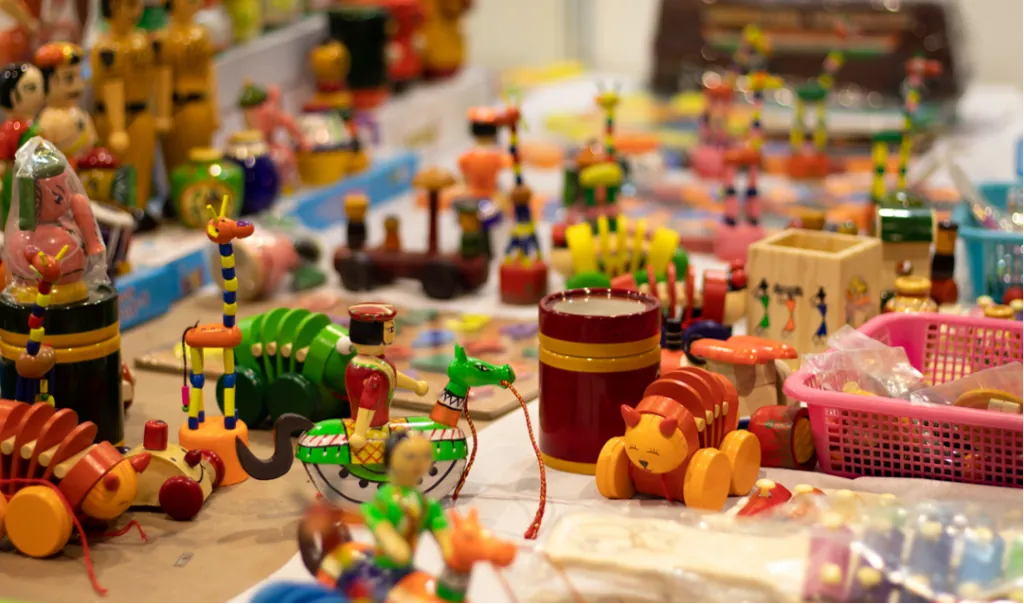
Chenghai, Shantou earns the title “Toy Gift Capital of China.” Plastic toys, electric models, remote-controlled cars, building blocks, and viral internet-famous toys dominate the production lines here. Supplying about a third of the world’s plastic toys, Chenghai thrives on robust foreign trade networks, a full product spectrum, and a dense cluster of factories — which means competitive quotations, but also wide quality variation between neighboring workshops.
- Shipai, Dongguan specializes in “trendy toys”: blind boxes, IP-based figurines, high-end brand OEM work, and smart toys. Renowned for meticulous craftsmanship and strict quality control culture, it is the go-to cluster for premium, design-driven products.
- Shenzhen leads in smart and electronic toys — from programmable robots to drones — with a focus on high-end exports that blend tech innovation with educational value.
Beyond Guangdong, other regions carve out their own niches:
- Yangzhou, Jiangsu is a powerhouse for plush toys, stuffed animals, dolls, and wedding gift plushies, offering large volumes at competitive prices. For an overview of what this category involves, see our guide to wholesale toys from China.
- Gaomi, Shandong complements this with plush toys and children’s carts, emphasizing cost-effectiveness.
- Yunhe, Lishui (Zhejiang), known as the “Hometown of Wooden Toys,” excels in log building blocks, early-education teaching aids, and solid wood toys, prized for their natural, durable appeal.
- Yiwu, Zhejiang remains the ultimate wholesale and export hub, catering to stall vendors, holiday-themed toys, and global traders seeking a one-stop marketplace for mixed assortments.
Whether you are after plastic electric toys (Chenghai), trendy IP figurines (Dongguan), plush dolls (Yangzhou), wooden educational toys (Yunhe), smart gadgets (Shenzhen), or wholesale assortments (Yiwu), this map points you directly to the right cluster. Our broader overview of China’s industry hubs by product covers how these clusters fit together for mixed-category buyers.
How Toy MOQs Work — and How to Start Small
Toy factories quote minimum order quantities based on where their costs sit, and the logic differs by category:
- Plastic and electric toys (Chenghai, Shenzhen). If the factory already produces your target item on an active line — same mold, same electronics — the MOQ can be modest, because the real cost is already amortized. If you need a new mold or a new color/finish, the factory must justify the tooling setup, and the MOQ rises accordingly.
- Plush toys (Yangzhou, Gaomi). MOQs are usually driven by fabric minimums and cutting efficiency. A stock fabric in a common color is easy to run; a custom-printed fabric or a special accessory needs a fabric mill minimum first, which flows into your MOQ.
- Wooden toys (Yunhe). Molds matter less, but finishing (painting, printing, water-based coating) drives minimums, especially for multi-color designs.
- IP figurines and blind boxes (Shipai). These are tooling-heavy and detail-sensitive. Expect the highest MOQs in the toy map, because each character and accessory typically involves dedicated tooling.
Two practical notes for small buyers. First, a factory’s MOQ is about their production economics, not a rule of the market — per-unit cost on a small trial order will be higher, and that is normal. Second, starting small is still worthwhile: a trial order on an existing product lets you test packaging, function, and your customers’ response before committing to a full container. Through our service, sample orders and trial purchases can start from a single piece (custom tooling projects are the exception), so you can validate a product before scale.
What Actually Drives the Cost of a Toy
Quotations for what looks like the “same” toy can vary widely between factories. The usual drivers:
- Materials. New ABS, food-grade silicone, solid wood, and certified fabrics cost more than economy alternatives. For children’s products, material choice is also a compliance question, not just a price question.
- Electronics count. Every motor, speaker, sensor, or light module adds cost and, importantly, adds testing scope and more potential failure points.
- Tooling amortization. A new mold may be quoted as a separate tooling fee or spread into the unit price over the agreed quantity. Ask which model the quotation uses — it changes both your cash flow and your flexibility to switch factories later.
- Finishing and packaging. Multi-color spray, water-transfer printing, window boxes, and blister inserts are labor steps that show up clearly in the unit price.
- Compliance testing. For export to regulated markets, third-party testing is typically billed per test series, per material group, and per color — see the next section.
Raw material prices and seasonal labor demand also move quotations over the year, so a price that was accurate last quarter may need reconfirming today. This is one reason we reconfirm current quotations with factories in writing for every new inquiry, rather than reusing old numbers.
Certifications and Compliance: Get This Right Before Production
Toys are among the most heavily regulated product categories in major markets, and the rules attach to the product you ship, not to the factory’s general reputation:
- United States. Children’s products require a Children’s Product Certificate (CPC) based on testing to ASTM F963, plus CPSIA limits on lead and phthalates, and a tracking label on the product and packaging.
- European Union. The EN 71 series (mechanical/physical properties, flammability, chemical migration) underpins CE marking for toys, supported by a Declaration of Conformity and correct age-grading warnings.
- Other markets. The UK, GCC states, Australia, and others each have their own requirements or accepted equivalents, which should be confirmed before you place the order — not at customs.
Two traps deserve special attention. First, an old test report is not automatically your report: factories often hold certificates for a similar SKU or an older material batch, and testing scope depends on colors, materials, and electronic modules actually used in your version. Second, testing fees sit outside the factory price. As a rule on all projects we handle, third-party testing fees are extra costs, confirmed with you in advance — along with freight — before anything is booked. Building this into your budget from day one avoids the classic situation where compliance is discovered as a surprise at the end.
Toy Quality Inspection: What Gets Checked and Why
Toys fail inspection for reasons that general consumer goods do not, so the checklist is category-specific:
- Small parts and choking hazards. For products intended for children under three, small components are tested with a small-parts cylinder, and attached parts (eyes, wheels, buttons) undergo pull and torque tests.
- Edges, points, and gaps. Sharp edges, accessible points, and finger-trap gaps are checked against the relevant standard’s limits.
- Paint and surface coatings. Heavy-metal limits and adhesion are the recurring issues, especially on brightly colored plastic and wooden toys.
- Function and durability. Drop tests, repeated operation of moving parts, and full function checks on electronic toys (switches, battery compartments, screw security) catch the failures that show up in customer returns.
- Labeling and packaging. Age grading, warning text, barcode, and language requirements are checked against your market — a frequent source of customs delays when skipped.
How inspection works with us, in three clear tiers. First, as part of our standard service, goods that arrive at our Guangzhou warehouse go through a receiving check — quantity, packaging, and visible defects, within the scope agreed for your order. Second, for buyers who want deeper coverage, factory audits, during-production checks, and pre-shipment inspection are available as optional services, quoted per project and delivered with reports and photos. Third, costs outside our service — freight and third-party testing fees — are always confirmed with you in advance. Which tier suits an order depends on the product’s risk profile and your market’s requirements, and we are happy to advise before you decide.
Common Pitfalls When Sourcing Toys from China
- The sample was good; the bulk order was not. Samples are made with the best workers and fresh materials. Without a defined standard (golden sample, agreed tolerances, agreed materials), mass production drifts. Fix the reference sample and inspection scope in writing before the order.
- Mold ownership left ambiguous. If you pay for tooling, clarify in writing who owns the mold and whether it can be moved. It determines how free you are to change suppliers later.
- IP and licensing risk. Trendy figurines and character merchandise are the fastest-growing corner of the toy map, and also the riskiest: unlicensed IP can lead to platform takedowns and customs seizures. Confirm the licensing basis of any IP product before ordering.
- Seasonal capacity squeeze. Holiday-season production capacity is booked months ahead in the major clusters. Late inquiries end up choosing between slower schedules and thinner factory attention.
- Packaging language and age grading mismatched to the market. Warnings printed in the wrong language, or age labels inconsistent with the design, create problems at customs and with market surveillance alike.
- Assuming a certificate covers your order. As covered above, testing scope follows your product’s materials, colors, and electronics. A factory-level certificate is a starting point for verification, not a substitute for it.
Frequently Asked Questions
What is the typical MOQ for toys from Chinese factories?
It depends on the category and whether the product already exists in the factory’s line. Running an existing plastic or plush item can start at modest quantities, while new tooling (custom molds, custom fabric, new electronics) pushes MOQs up. Our overview of wholesale toy sourcing from China explains how this plays out per category.
Can I order samples before committing to a bulk order?
Yes. Sample orders through our service can start from a single piece (custom tooling projects excepted), so you can evaluate the product, packaging, and supplier communication before any volume commitment.
Which certifications do I need to sell toys in the US or EU?
For the US: a CPC based on ASTM F963 and CPSIA testing, plus tracking labels. For the EU: EN 71 testing underpinning CE marking, with a Declaration of Conformity and correct warnings. The exact test series depends on your product’s materials and features, and third-party testing fees are confirmed with you in advance before booking.
How is toy quality checked?
In three tiers: a receiving check at our Guangzhou warehouse is included in our standard service (quantity, packaging, visible defects, per the scope agreed for your order); factory audits, during-production checks, and pre-shipment inspection are optional services quoted per project with reports and photos; and external costs such as freight and third-party testing are confirmed upfront.
What does a sourcing company charge?
Our service fee starts at 5% — the full breakdown, what is included, and what is quoted per project are published on our pricing page.
When should I start production for the holiday season?
Earlier than feels necessary. In the major toy clusters, holiday-season capacity is committed months in advance, and the strongest factories’ schedules fill first. Confirm your product, compliance scope, and quotation early, then lock the production slot.
Talk to a Team That Sources in These Clusters Every Week
Since 2021, Select Trade has supported 798+ buyers across five continents, drawing on 1,500+ factory resources across China’s manufacturing clusters and 5,815+ products sourced. If you are evaluating a toy product or building a category plan, add us on WhatsApp at 008613202073761 — please include your product category and how you found us. We will point you to the right cluster, the right questions, and a quotation you can compare on equal terms.
