
Wholesale Charcoal Kettle Grills from China
The charcoal kettle grill is a mature product with a mature supply chain, and the factories that make it well are easy to name because the tolerance stack is unforgiving: a coated steel bowl, a lid that must seat, vents that must move, and a coating that must survive fire from beneath and weather from above.
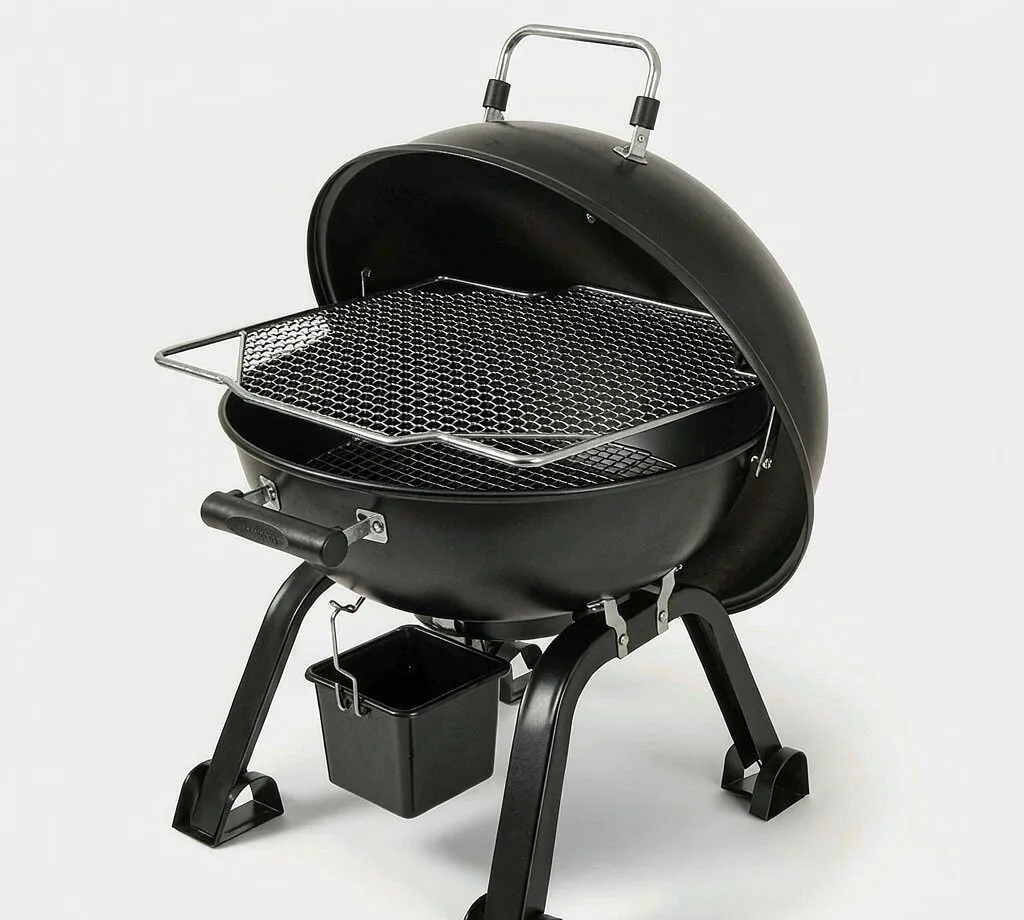
The failures are the predictable ones. The porcelain enamel chips at the rim because the steel was degreased poorly before coating, the lid does not seat and the vent control loses its authority, or the ash catcher does not line up with the bowl, which turns cleanup into the reason the customer replaces the grill.
All three are visible or testable on a bulk unit. The cluster context is in our wholesale outdoor products overview.
Bowl, coating and the fit
Bowl and lid are pressed steel coated in porcelain enamel, a glass layer fused in a kiln. Coating quality is a surface preparation story: steel that is not perfectly clean produces a coat that looks fine and chips at the edges. Wall thickness decides heat retention, and heat retention is what a kettle grill is actually sold on.
The fit between lid, bowl, vents and ash catcher is the second axis. A kettle controls heat by moving air, and the vent dampers are the control surface; dampers that bind or fall out turn a controllable grill into a bonfire. The one touch ash system, where a bowl swings under the fire bowl, is the feature most often misaligned on cheap runs.
Specifications and minimum order
Steel and enamel costs track raw materials and kiln energy, so live figures come with the quotation. Fix these points.
| Specification | What to confirm before you order |
|---|---|
| Bowl and lid | Steel thickness, and the porcelain enamel process named |
| Cooking grate | Plated steel or cast iron, with the bar diameter |
| Vents | Damper design, movement tolerance and the closure fit |
| Ash system | Removable catcher or one touch sweep, and the alignment standard |
| Legs and wheels | Tube spec, wheel grade and the stability footprint |
| Heat test | The burn protocol the assembled grill must pass |
| Pedido mínimo | Set by pressing and kiln batches, hundreds per colourway in practice |
Our minimum order is 1 piece, so a burned, cleaned and reassembled sample is approved before any production commitment. The production minimum follows the pressing and kiln schedule, and we confirm it against your spec. Our sourcing service screens the metal plants, which concentrate around a few clusters.
The burn test is the acceptance test
A kettle grill is bought to burn charcoal, and the acceptance test is a burn: load it, light it, run it through a full cook, then inspect the coating, the vent movement and the ash system hot and cold. Factories that burn test bulk units ship grills that work; factories that only inspect the coating statically ship the complaints.
Rust in transit is the second structural issue. A grill is steel in a damp container for weeks, and the packing spec, with the coating complete on hidden surfaces, decides whether the customer opens rust or porcelain. Our packing service covers the export packing layer for consolidated loads.
What belongs in the purchase order
- Steel thickness for bowl and lid, and the enamel process named
- Grate material and bar diameter
- Vent damper design and the movement standard
- Ash system type and the alignment tolerance
- Legs, wheels and the stability footprint
- Burn protocol with a pass standard, run on bulk production
Checks that catch the repeat failures
- Coating edge check. Inspect rim and vent edges on bulk units; chipping at edges means poor pre coat cleaning.
- Burn test. Run a full cook on a bulk grill, then recheck coating, vents and fit hot and after cooling.
- Lid seating. Seat the lid on three bulk grills; gap variance shows the tolerance stack immediately.
- Vent cycle. Move every damper through its range twenty times; binding or falling dampers fail here.
- Ash alignment. Swing the ash system through a full cycle; misalignment shows as a jam or a gap.
These checks are standard work in a pre shipment inspection, and our factory inspection service covers metal product plants. For the fuller method, see our pre shipment inspection guide.
Preguntas frecuentes
Why does coating quality vary so much between factories?
Because porcelain enamel is a kiln process on prepared steel, and the preparation is the part no photograph shows. Two factories can buy the same frit and produce different coats. We verify with the edge and burn checks on bulk units, not on showroom samples.
Is a bigger kettle better for retail?
Size is a market position decision, not a quality one; the tolerance stack is what decides returns. Buy the size your shelf plan needs and put the money into wall thickness and vent quality. Our minimum order is 1 piece for sampling any size.
What fails first on a cheap kettle?
The vents, then the coating at the edges, then the ash alignment. All three are mechanical or visual checks that take minutes on a bulk unit, which is why this category rewards a loading inspection more than most.
Request a quotation
Send the size, the features you want and your market. We come back with factory options plus the workable minimum within two business days.
