
Wholesale Stainless Steel Pot Sets from China
The stainless pot set is the anchor product of the cookware trade. It sells as a wedding gift, as a housewarming present and as a retail hero display, and it is judged across a decade of use rather than a single meal. That long judgement is exactly why the shortcuts hidden inside it matter: they surface months later as a warped base or a loose handle, long after the invoice was paid.
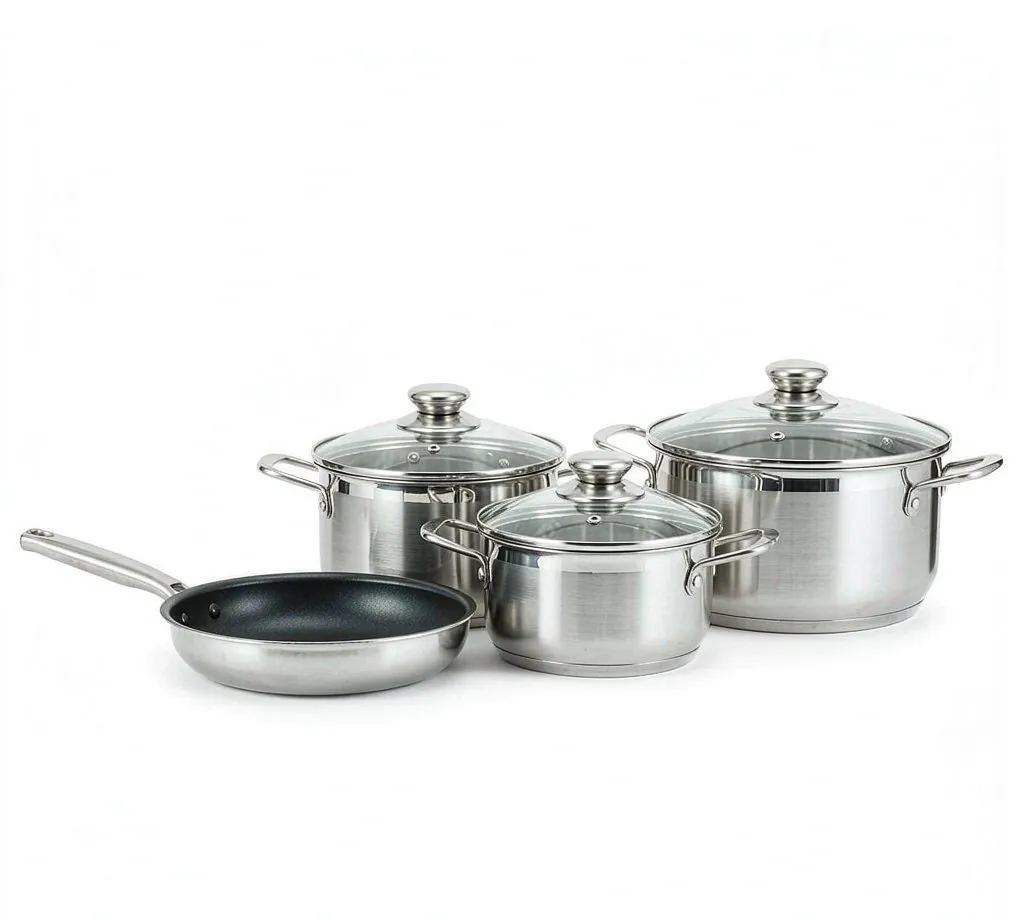 The photograph shows a representative set from the category. Piece list, steel grade and handle style follow the order sheet, and the image is illustrative rather than a picture of your goods.
We have sourced cookware out of Yongkang and the Guangdong clusters for five years. The same three failures come back. A base sold as multi-layer bonding arrives with a thin aluminium core, so the pan heats unevenly and scorches. Handles loosen because the rivet count was reduced on the bulk run. And a lid that fit the sample sits a millimetre proud in bulk, which is the difference between a sealed simmer and a rattling boil.
This page covers what the steel and bonding words mean, what belongs on the order sheet, and the checks that catch a weak lot. The cluster map behind the category is in our wholesale kitchenware overview.
Steel, bonding and the base
The steel grade is the specification most worth pinning down. The 304 grade, often written as 18/8 for its chromium and nickel content, is the honest default for food contact: it resists corrosion and holds a finish. The 201 grade looks identical and corrodes sooner, and it is the classic quiet substitution in this category. A magnet is a crude but effective first check, because 304 is barely magnetic and 201 is not.
The base is where cooking performance lives. A bonded base layers aluminium between steel to spread heat, and the layer thickness decides whether the pan cooks evenly or scorches in the centre. Fully cladded bodies bond the layers up the sides and cost more; disc-bottom builds are the volume standard. Whichever you buy, the bonding layer belongs in the specification, because it is invisible once the base is capped.
Finish is the third decision. A mirror polish photographs beautifully and shows every fingerprint; a brushed finish hides daily use and reads professional. Interior finishes and etched capacity marks are small line items that retail buyers notice, and they cost little when specified before production rather than argued after.
Specifications and minimum order
Our minimum order is 1 piece, so you can start with a single unit and scale up once the sample is approved. Every line below changes what the factory builds. We do not print prices or schedules here, because steel prices move; send us the piece list, the grade and the quantity, and we come back with a live quotation and a firm production slot.
| Specification | What to confirm before you order |
|---|---|
| Steel grade | 304 or 201 named, with the interior surface finish stated |
| Base build | disc-bottom or fully cladded, with the aluminium layer thickness named |
| Piece list | every pot and lid itemised by diameter and depth, since sets are sold by inventory |
| Handles | rivet count and handle material, stated rather than implied |
| Lids | glass or steel, with the fit checked against the rim |
| Packaging | colour sleeve or gift box, with the packing that protects the rims |
| Minimum order | stated per set configuration, since each mix is its own production run |
Minimums in cookware are driven by tooling and press setups, and a standard piece list in one grade is the most consistent way to start. Our sourcing service covers the factory screening, the sample round and the inspections below.
What the food-contact words mean
Food-contact compliance is a paperwork layer with teeth. The major markets require the materials touching food to meet migration limits, and the certificate has to cover the actual grade and finish being shipped. A factory that exports to your market should hold current test reports for its standard builds, and the report should name the steel grade, because a report for one build does not cover a substituted one.
Weld and rivet quality is the mechanical half of the same question. A handle attached with fewer rivets passes a visual check and fails after a year of lifting. The reliable check is physical: lift a filled pot by the handle from the bulk lot and look for movement at the mount. That single test catches the most common mechanical shortcut in the category.
Two practical points complete the picture. Rims are the part that dents in transit, and a dented rim breaks the lid seal, so the packing method matters more in cookware than the piece count suggests. And flatness is testable: a pot base that rocks on a flat surface will never sit evenly on an induction hob, and the check takes seconds.
What belongs in the purchase order
One page attached to the PO is what protects the reorder. Cover these points:
- Steel grade and interior finish, named, with the food-contact report reference
- Base build with the aluminium layer thickness stated
- Complete piece list by diameter and depth
- Handle rivet count and lid specification
- Packing that protects rims and mirror finishes in a sea container
- A penalty clause if the bulk set differs from the approved sample
Inspection points that catch a weak lot
These checks find what a product photograph cannot:
- Magnet test the grade. Check bulk pieces against the grade claim. A magnetic 304 claim is a substitution.
- Lift by the handle. Fill a pot from the bulk and lift it by the handle. Movement at the mount is the failure customers report.
- Rocker test the base. Press each corner of the base on a flat surface. A rocking base is a pan that never sits right.
- Check the lid fit. Seat lids on pots from different cartons. A proud lid breaks the simmer the set was sold on.
- Look inside. Check the interior finish and the bonding cap for tool marks and thin spots on pieces from the bulk.
An independent inspection before loading catches all five at the cheapest point, and the grade and handle checks are the two that protect a cookware programme. Factory inspection covers this category, and the supply towns behind it are mapped in our kitchenware hotspots guide.
Frequently asked questions
304 or 201 stainless steel?
304 for anything touching food and carrying your brand, without exception on a cookware programme. The two grades look identical and cost differently, which is exactly why the substitution happens. The magnet check at inspection, plus the grade named on the invoice, keeps it honest.
Disc bottom or fully cladded?
Disc bottom is the volume standard and cooks well when the aluminium layer is properly specified. Fully cladded earns its price on premium ranges where heat up the walls matters. Both are honest builds; the mistake is buying one and receiving the other, which is why the base build belongs on the order sheet.
Can one pot set serve several markets?
The metal can, but the piece list and the packaging are market-specific: induction compatibility, handle styles and colour preferences all differ. The efficient structure is one core build with market-specific packing, agreed before production rather than negotiated after.
Request a quotation
Send the piece list, the steel grade and the quantity you need, plus the market you sell into. We come back with factory options and current bands within two business days.
