
Wholesale Wooden Toy Sets from China
Wooden toys sit at the quiet end of the toy trade. They sell to parents who are deliberately avoiding plastic, they carry a price that reflects real material, and the manufacturing problems they bring are almost the opposite of an injection-moulded run: not flash and colour drift, but moisture, finish adhesion and an edge that was rounded on the sample and left sharp in bulk.
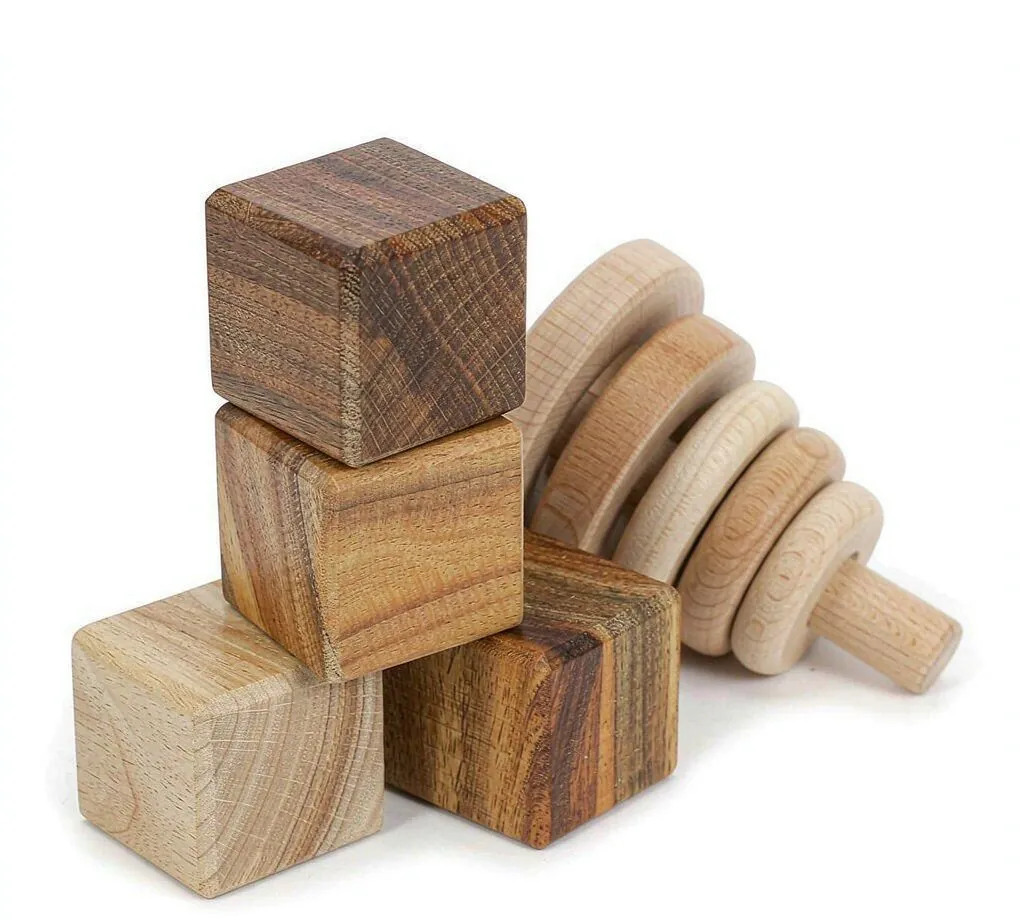 The photograph shows a representative set from the category. Your timber, finish and piece count follow the order sheet, and the image is illustrative rather than a picture of your goods.
We have sourced wooden toys out of the Yunhe cluster in Zhejiang and out of Shandong for five years. Three failures keep coming back. Timber arrives with a moisture content high enough that pieces crack in a dry shop or a heated home. A finish is switched from water-based to a cheaper solvent product between sample and bulk. Edges and corners are sanded by hand at the bench, so quality varies from operator to operator inside one carton.
This page covers what the timber and finish words mean in practice, what belongs on the order sheet, and the checks that catch a weak lot. The wider map of who makes what is in our wholesale toys overview.
Timber, finish and joinery: the three decisions
Timber decides how the set survives its life. Beech is hard, dense and holds a fine edge, which is why it dominates stacking and threading toys. Rubberwood is softer, cheaper and perfectly serviceable when the grain is filled properly. Pine and lighter species cut cost again but dent visibly and take paint unevenly. Naming the species on the invoice is the only way to keep a reorder identical, because the factory will substitute on price otherwise.
Finish decides which market the set can enter. Water-based lacquer is the default for anything aimed at young children, since it carries the lowest migration risk and the least odour out of the carton. Solvent finishes are cheaper and harder, and they are also the most common silent substitution in this category. The chemical test family for toy surface coatings is what catches that swap.
Joinery decides how the set ages. A glued dowel joint with a mechanical pin is standard for pieces a child pulls apart; a glued joint alone will fail in a dry room. Screws are acceptable on structural pieces, but they should be countersunk and capped so no thread is reachable by a small finger.
Specifications and minimum order
Our minimum order is 1 piece, so you can start with a single unit and scale up once the sample is approved. Every line below changes what the factory cuts or finishes, so all of it belongs on the order sheet in writing. We do not print prices or schedules here, because timber prices and workshop calendars both move; send us the piece list, the species and the quantity, and we come back with a live quotation and a firm slot.
| Specification | What to confirm before you order |
|---|---|
| Species | beech, rubberwood, pine or another species, named on the invoice |
| Moisture content | the target range in per cent, and how the factory measures it before finishing |
| Finish | water-based or solvent, with the colour matched to a sealed finished piece |
| Edge treatment | the radius required on every external edge, stated in millimetres |
| Joinery | dowel, screw or interlocking, with any exposed fastener capped |
| Piece list | the count and dimensions of every component, since a set is sold by its inventory |
| Minimum order | stated per set and per finish colour, because each finish colour is its own batch |
Minimums in this category sit higher than in plastic toys because there is no reusable mould to amortise; the setup is in cutting, drying and finishing. Our sourcing service covers the factory screening, the sample round and the inspections set out below.
How coating and timber rules shape the order
Surface coatings on toys are tested for migration of certain elements, and the test applies to the finished surface rather than to the raw paint tin. That distinction matters: a compliant lacquer applied over an incompatible primer, or cured at the wrong temperature, produces a coating that fails even though the supplier’s certificate is genuine. The report has to be run on finished pieces from the actual line.
Timber itself carries a moisture and formaldehyde question. Wood that has not been dried to a stable range moves after assembly, which shows up as cracks, loose joints and a set that no longer stacks. Board products used in a set, such as a puzzle base or a box base, carry formaldehyde release requirements that solid timber does not.
Two commercial points round this out. Sets are sold by piece count, so a supplier who quietly drops one block from a set has reduced the value without changing the box. And sanding is hand work, which means the edge standard has to be measured on pieces from the bulk lot rather than judged from a sample that one skilled operator prepared.
What belongs in the purchase order
One page attached to the PO is what protects the reorder. Cover these points:
- Species and moisture content range, with the measurement method agreed
- Finish type and a sealed finished sample retained by both sides for colour reference
- Edge radius and the sanding standard, stated numerically rather than described
- Complete piece list with count and dimensions for every component in the set
- Packing method that protects finished edges, since chipped paint is a claim
- A penalty clause if the bulk set differs from the approved sample
Inspection points that catch a weak lot
These checks find what a finished product photograph hides completely:
- Run a finger along every edge. Check pieces from several cartons, not one. Sanding quality varies by operator on the same line.
- Test finish adhesion. Press and lift tape on a finished surface, or score a small grid, to see whether the coating lifts.
- Measure moisture. Use a meter on pieces drawn from the bulk. Wood outside the agreed range will move after it reaches a dry room.
- Count the set. Open a carton and count the components against the piece list. Missing pieces are the most common silent claim in this category.
- Check the smell. A strong solvent smell out of a sealed bag means the finish is not what was invoiced.
An independent inspection before loading is where all five are cheap to fix, and it is far less expensive than a container of cracking sets. Factory inspection covers this work, and the cluster logic behind it is set out in our industry hubs guide.
Frequently asked questions
Which timber should a first wooden toy order use?
Beech is the safest default for anything a child handles hard, because it holds an edge and takes paint evenly. Rubberwood is the reasonable step down when price matters more than density. Whichever you choose, fix the species in writing, because substituting species is the easiest way for a factory to protect a margin without changing the drawing.
Does a wooden toy need chemical testing?
Yes if it carries any coating, print or glue, because the test applies to the finished surface. Plain unfinished timber in a market that still requires a general toy report also needs mechanical testing for edges and small parts. Most factories hold reports for their standard finishes and will extend one to your item, which is far quicker than commissioning a new test.
How do I stop edges chipping in transit?
Specify the packing rather than hoping for it. A finished piece that rattles against another in the carton will arrive with chipped paint on the corners, and the cost of a divider or a moulded tray is a fraction of a returned shipment. Put the requirement in the purchase order and inspect a carton from the middle of the stack.
Request a quotation
Send the piece list, the timber, the finish and the quantity you need, plus the market you sell into. We come back with factory options and current bands within two business days.
