
Wholesale Gel Pens and Rollerball Pens from China
Gel pens are the writing upgrade of the stationery trade. The ink is a pigment suspended in a gel rather than an oil paste, which is why the line is denser, darker and smoother than a ballpoint at the same tip size. It is also why the category has failure modes a ballpoint does not: gel dries out, separates and clogs in ways that only appear after storage or a hot summer.
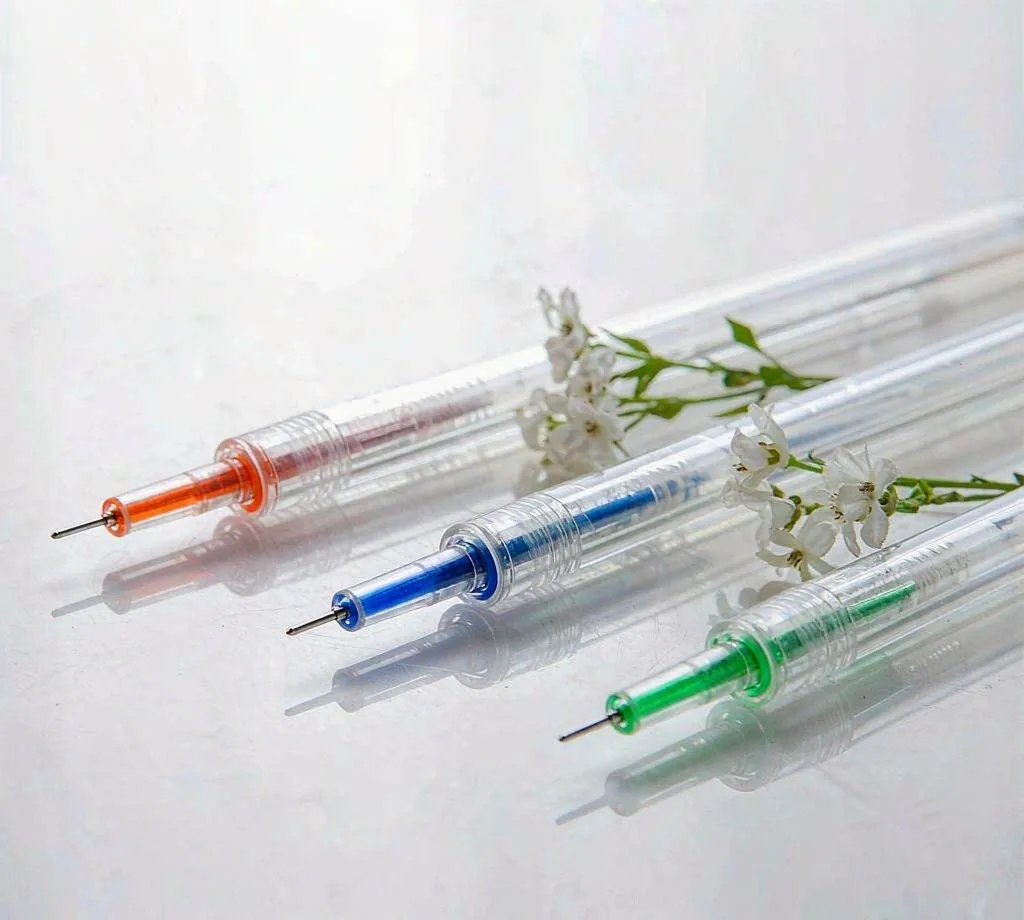 The photograph shows representative pens from the category. Tip type, ink colour and packaging follow the order sheet, and the image is illustrative rather than a picture of your goods.
We have sourced gel and rollerball pens out of the Wenzhou and Ningbo belts for five years. The same three failures come back. A needle tip that wrote beautifully on the sample clogs in the bulk run because the sealing step was rushed. A coloured gel fades on the shelf because a dye-based ink replaced the pigment one. And a cap that claimed hours of cap-off time fails after minutes, drying the first pen in the box.
This page covers what the tip and ink words mean, what belongs on the order sheet, and the checks that catch a weak lot. The wider cluster picture is in our wholesale stationery overview.
Tip geometry and ink chemistry
Two tip families dominate the category. A needle tip is a fine metal tube, preferred for detail work and smaller line widths. A conical or bullet tip carries the ball further forward and writes smoother across a range of angles. Both are sold by ball size, and the difference between adjacent sizes is clearly visible on paper, which makes the tip the first thing to verify on a bulk lot.
Gel ink comes in two grades worth separating. Pigment-based gel is the durable ink: light-fast, water-resistant once dry, and the reason a signed document stays legible. Dye-based gel is cheaper and brighter, and it fades and bleeds. Neither is wrong, but the invoice should name which one is in the barrel, because a dye ink substituted into a pigment order shows up only after the goods reach a sunny shelf.
Rollerballs sit between gel and ballpoint: liquid ink, a wetter line, and a feed system that needs better sealing. They reward the same tests as gel with an extra eye on how the pen behaves stored on its side, which is how most retail packs sit on a shelf.
Specifications and minimum order
Our minimum order is 1 piece, so you can start with a single unit and scale up once the sample is approved. Every line below changes what the factory fills or fits. We do not print prices or schedules here, because ink inputs and factory calendars both move; send us the tip, the ink and the quantity, and we come back with a live quotation and a firm production slot.
| Specification | What to confirm before you order |
|---|---|
| Tip type and size | needle or conical, with the ball size named per line item |
| Ink type | pigment gel or dye gel, named, with light-fastness stated for coloured inks |
| Ink colours | each colour referenced to a retention sample kept by both sides |
| Cap-off time | the duration the uncapped pen is claimed to survive, and how it was measured |
| Storage claim | the shelf life and the temperature range the ink is specified for |
| Barrel and grip | transparent or opaque barrel, and whether the grip is rubber or moulded |
| Minimum order | stated per colour, since every ink colour is its own filling batch |
Minimums track ink batches rather than barrel volumes, which is why a twelve-colour launch costs far more to set up than a three-colour core range. Our sourcing service covers the factory screening, the sample round and the inspections below.
What the cap-off and storage words mean
Cap-off time is how long a pen writes after being left uncapped. It is governed by the sealing design of the cap and the ink’s own drying behaviour, and it is the spec most often quoted optimistically. The honest way to buy is to state the requirement in minutes and to test it on bulk stock, not on the sample room pen.
Storage behaviour is the other quiet failure. A gel that has separated after a hot sea crossing will skip from the first stroke, and no amount of shaking fixes it. Factories that build for export specify their inks for the temperature range a container actually reaches, and asking for that specification is what separates a pen that writes in July from one that does not.
One further point belongs in every gel order. Pigment ink that resists water is also, by definition, harder to remove from clothing. Markets that sell to schools expect that trade-off, but the packaging should say so honestly, because a parent with a stained uniform is the loudest reviewer a stationery brand ever gets.
What belongs in the purchase order
One page attached to the PO is what protects the reorder. Cover these points:
- Tip type and ball size per line item, with the sample retained by both sides
- Ink type named as pigment or dye, with the colour and retention sample
- Cap-off time in minutes and storage temperature range, both as testable claims
- Barrel style, grip material and packaging configuration
- Carton packing that keeps ink from freezing or cooking, depending on the destination season
- A penalty clause if the bulk ink differs from the approved retention sample
Inspection points that catch a weak lot
These checks find what a product photograph cannot:
- Write from every carton. Draw continuous circles with pens drawn from several cartons, not one. Skipping and clogging appear immediately.
- Cap-off test. Uncap pens for the stated duration, then write. A pen that fails its own claim generates the returns.
- Ink density. Compare line darkness against the retention sample. A dye ink substituted for pigment is visibly lighter.
- Seal and leakage. Stand pens tip-down overnight from the bulk lot. A wet tip in the morning is a leak.
- Grip and barrel fit. Twist the grip section on a handful of pens. Loose grips loosen further in a pencil case.
An independent inspection before loading catches all five at the cheapest possible point, and it is the only stage at which a clogging problem can still be fixed before the goods ship. Factory inspection covers this category, and the wider inspection logic is set out in our sample-versus-bulk guide.
Frequently asked questions
Pigment or dye gel ink: which should I order?
Pigment for anything that has to last, including school and office lines where documents are signed. Dye for craft, colouring and promotional ranges where brightness matters more than permanence. The mistake is not choosing one over the other; it is not saying which one you are buying and letting the factory decide.
Why do gel pens skip after shipping?
Most skipping is a storage problem rather than a quality problem at the moment of production. Gel separates or thickens outside its specified temperature range, and a container in summer or winter sits well outside it. Specifying the storage range and packing the cartons for the season they will actually cross is what fixes it.
How many ink colours can one order carry?
As many as the factory can fill, but each colour is its own batch with its own setup and its own retention sample. A three-colour core range with colourways added on the reorder is usually more consistent than a twelve-colour launch, because fewer batches have to match each other.
Request a quotation
Send the tip size, the ink type, the colours and the quantity you need, plus the market you sell into. We come back with factory options and current bands within two business days.
