
Wholesale Rigid Gift Boxes with Liner from China
A rigid box is the packaging customers keep. The walls are thick greyboard wrapped in printed paper, specialty paper or cloth, and the liner inside holds the product in place. Jewelry, electronics, spirits, skincare and gift brands all depend on the format, and it is the most hand-worked packaging in any factory, which is where both the cost and the risk sit.
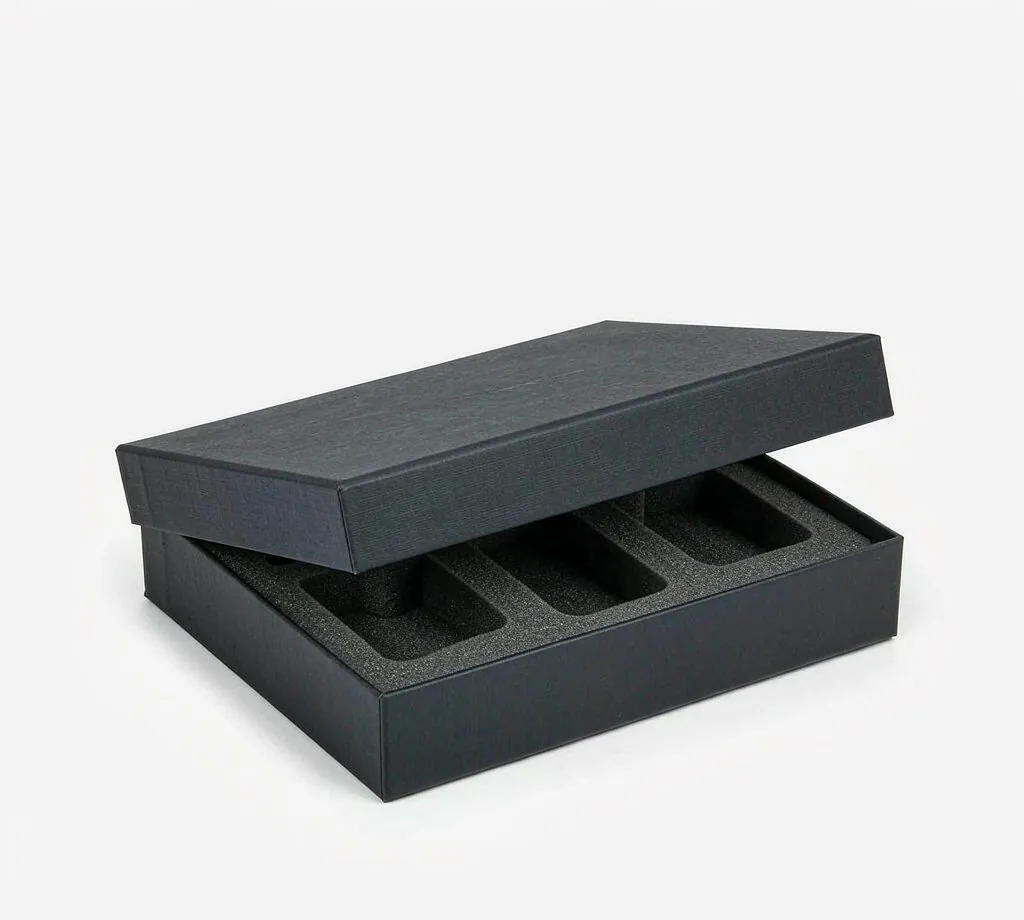
The recurring failures are specific. The wrap bubbles or lifts at the corners because the glue was brushed unevenly on a humid day. The liner sits proud of the walls, so the lid does not close. Or the greyboard is thinner than specified, and the box that felt substantial in the sample batch arrives soft enough to dent with a thumbnail.
Every one of these is visible on a finished box from the bulk lot, minutes before loading. This page covers the specification and the checks; the cluster context is in our wholesale packaging overview.
Anatomy of a rigid box
Three layers decide everything. The greyboard skeleton gives the box its strength and is quoted by thickness in millimetres. The wrap is the printed or specialty paper laminated over the board. The liner, cut from EVA foam, moulded pulp or folded paperboard, is the fitment that stops the product moving, and on a lined gift box it is usually the component the factory gets wrong first.
The lid and base are made as separate pieces and must be checked as a pair: clearance, drop and the magnetic catch if there is one. A box that closes with a satisfying click is the sum of tolerances across all three layers, and the sample is where that sum gets right.
Specifications and minimum order
Greyboard, wrap stock and foam prices move with the raw material markets, so figures are quoted live rather than printed here. Fix these points instead.
| Specification | What to confirm before you order |
|---|---|
| Greyboard thickness | Millimetres per wall, lid and base stated separately if they differ |
| Wrap material | Art paper, specialty paper or cloth, with the weight in grams |
| Print and finish | Offset colour, hot foil, emboss or deboss, spot UV, per panel |
| Liner type | EVA, moulded pulp or folded board, with a cavity drawing |
| Lid fit | Drop depth and clearance, agreed on a physical sample pair |
| Magnet | Pull force and placement, if the design closes magnetically |
| Pedido mínimo | Lower than cartons because the work is manual, but tooling and wrap dies set a floor; confirm against your structure |
Our minimum order is 1 piece, so you can approve the physical sample before any production commitment. For the production run the factory minimum follows the structure and the wrap dies, and we confirm the figure in writing. Our sourcing service coordinates the sample round and the factory screening.
Hand assembly is where quality is won
Unlike a folding carton, a rigid box passes through many pairs of hands: board cutting, slotting, taping the skeleton, wrapping, lining and cleaning. Skill level varies across the workers on one line, and output in the last hour of a shift is not the same as the first. This is why bulk lot inspection matters more here than in any other packaging category.
Humidity is the second factor. Wrap glue behaves differently in a Guangzhou June than in a dry winter, and bubbling that never appears in a winter sample batch can appear across a summer run. The factory that knows this adjusts glue mix and drying time; the factory that does not ships the bubbles.
What belongs in the purchase order
- Greyboard thickness per component, and the board density if the walls are laminated
- Wrap material with weight, and the colour standard retained by both sides
- The approved liner cavity drawing, with the revision number
- Lid and base dimensions as a mated pair, with clearance stated
- Magnet pull force, if used, measured in the sample and repeated on the bulk
- Assembly grade: state that bulk units are checked against the approved sample, not the drawing
Checks that catch the repeat failures
- Corner wrap. Look at all four corners of a bulk unit under a raking light. Bubbles and lifting paper show immediately.
- Board stiffness. Press a wall with a thumb against a hard surface. The difference between 1.5 mm and 1.2 mm greyboard is felt, not seen.
- Lid drop test. Close the lid ten times on a bulk box. It should seat with the same resistance as the approved sample.
- Liner height. Set the product in place and close. A proud liner is a packing line problem discovered at your cost, not the factory.
- Glue smell. A strong solvent smell from the liner glue fades slowly and travels into the product; check a boxed unit after two days.
These are all part of a standard pre shipment inspection, and our factory inspection service covers jewelry and gift packaging in particular. For the inspection method in detail, see our sample versus bulk inspection guide.
Preguntas frecuentes
Why is a rigid box so much more expensive than a carton?
Material and labour. The greyboard alone weighs several times more than folding boxboard, and the assembly is manual where a carton is machine folded and glued. The format earns its cost on products where the box is part of the brand experience and the customer keeps it.
Can the liner be changed without redoing the box?
Usually yes for the insert, since it is a separate component, as long as the cavity drawing changes do not push the product above the wall height. Keep the box structure frozen and revise the liner drawing independently, which keeps the change cheap and fast.
What is the smallest run a factory will take?
Rigid box minimums are lower than carton minimums because the work is hand assembly, but the wrap dies and the greyboard die cutting set a floor per structure. Our minimum order is 1 piece for sampling, and we negotiate the production minimum against your exact specification rather than quoting a blanket number.
Request a quotation
Send the product dimensions, the structure you have in mind and your market. We come back with factory options, liner suggestions and the workable minimum within two business days.
