
Wholesale Glass Food Storage Sets from China
Glass storage sets sell on a promise the customer tests immediately: the container that goes from freezer to oven without a thought. That promise is a material property, not a marketing line, and it is exactly where the category’s one dangerous substitution lives. Everything else about a set, the lids, the seals, the nesting, is quality; the glass type is safety.
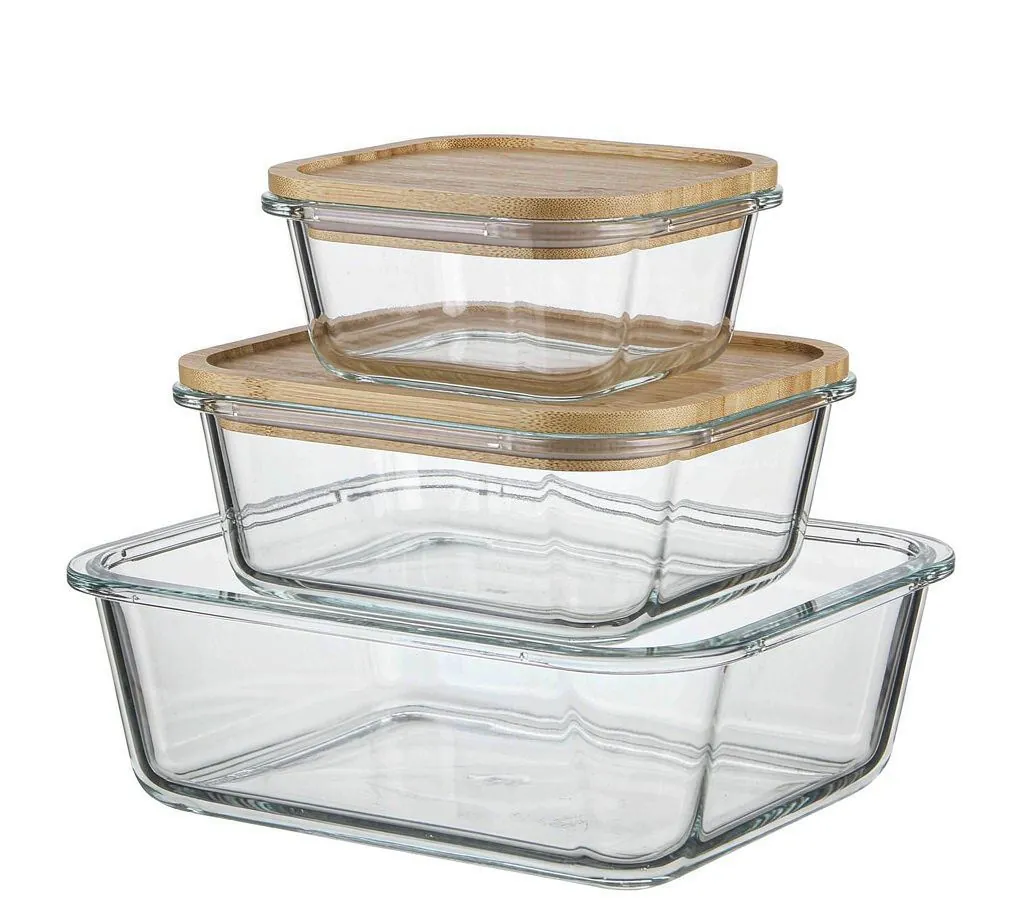 The photograph shows a representative set from the category. Sizes, lid material and seal type follow the order sheet, and the image is illustrative rather than a picture of your goods.
We have sourced glass storage out of the Guangdong and Zhejiang clusters for five years. The same three failures come back. A set sold as borosilicate is soda-lime glass in the same shape, which passes every look check and cracks under thermal shock in the customer’s kitchen. A lid seal that held on the sample lets liquid weep into a work bag. And rims chipped in transit, because nested glass travelled without protection.
This page covers what the glass words mean, what belongs on the order sheet, and the checks that catch a weak lot. The cluster map is in our wholesale kitchenware overview.
Borosilicate, soda-lime and the honest difference
Borosilicate glass expands far less with heat than ordinary soda-lime glass, which is why it survives the freezer-to-oven journey that storage sets are sold on. Soda-lime is cheaper, perfectly good for jars and cold storage, and genuinely unsafe in the use case the storage set advertises. The two look identical, weigh differently, and the substitution is invisible until the container cracks in a hot oven.
The verification is physical and cheap. A thermal shock test, moving a chilled container into hot water, is the honest check, and it is part of any serious inspection for this category. A polariscope reveals internal stress in the glass, which is where hidden weakness sits. Both checks exist because the paperwork is only as good as the glass that arrived.
Wall thickness and uniformity decide durability in daily use. A container with a thick base and thin walls carries stress unevenly and chips at the thin zones. The rim is the part that chips first in every glass category, and it is the part the packing protects or does not.
Specifications and minimum order
Our minimum order is 1 piece, so you can start with a single unit and scale up once the sample is approved. Every line below changes what the factory makes. We do not print prices or schedules here, because glass and lid inputs move; send us the size set, the lid style and the quantity, and we come back with a live quotation and a firm production slot.
| Specification | What to confirm before you order |
|---|---|
| Glass type | borosilicate named, with the right to verify by thermal shock testing |
| Size set | capacities itemised per container, since sets are sold by inventory |
| Lid | bamboo, plastic or glass, with the gasket material named |
| Seal | the leak claim, and the clip or friction fit that provides it |
| Use claims | oven, microwave, freezer and dishwasher limits stated as the set allows |
| Packing | individual boxes with rim protection, since nested glass chips in transit |
| Pedido mínimo | stated per size set, since each capacity is its own mould |
Minimums in glass track mould ownership, and a standard four-size set runs more consistently than a custom spread. Our sourcing service covers the factory screening, the sample round and the tests below.
What the lid and seal words mean
Bamboo lids photograph beautifully and swell in a dishwasher, which is why the honest sets label them hand-wash only. Plastic lids survive dishwashers and show stains. Glass lids survive everything and cost the freight. The choice is a channel decision, and the care instructions have to match the material or the reviews will do the telling.
The gasket is the seal. Silicone gaskets that recover after compression keep bags dry; cheaper compounds set flat and weep. The leak test is physical: fill, lid, invert, wait. For a product marketed on taking lunch to work, that test belongs in the inspection plan, because weeping is the failure that gets photographed and posted.
Two practical points complete the set. Sets nest for shipping, and nesting without separation is how rims chip, so individual boxes or separators are a packing decision that costs pennies. And the capacity marks matter to buyers who portion food; etched marks outlast printed ones and cost little when specified before production.
What belongs in the purchase order
One page attached to the PO is what protects the reorder. Cover these points:
- Glass type named as borosilicate, with the thermal shock test agreed
- Capacities itemised, with wall thickness stated
- Lid material, gasket compound and the leak test the lot must pass
- Use claims matched to the material, printed on the packaging
- Packing with rim protection per piece
- A penalty clause if the bulk set differs from the approved sample
Inspection points that catch a weak lot
These checks find what a product photograph cannot:
- Run the thermal shock test. Move chilled bulk containers into hot water. A soda-lime substitution shows itself here, and it is a safety finding.
- Run the leak test. Fill, lid and invert containers from several cartons. A weeping gasket is the most-posted complaint.
- Check the rims. Run a finger around every rim on the outer layer and inside the stack. Chipped rims are the transit claim.
- Weigh against the sample. A lighter container is a thinner wall, and thin walls chip in use.
- Work the lid. Seat and remove lids repeatedly. A lid that loosens after a few uses fails in a work bag.
An independent inspection before loading catches all five at the cheapest point, and the thermal shock test is the one that keeps a safety claim safe. Factory inspection covers this category, and the supply towns behind it are mapped in our kitchenware hotspots guide.
Preguntas frecuentes
How do I verify a borosilicate claim?
Test it. The thermal shock check, chilled container into hot water, is quick and honest, and a factory selling genuine borosilicate will welcome it. Paperwork helps, but the glass that arrived is the glass that matters, and the test measures the glass.
Bamboo or plastic lids?
Bamboo for the look and the gift channel, labelled hand-wash only. Plastic for dishwasher survival and family use. Both are honest builds; the failure is care instructions that do not match the material, which turns a good product into a bad review.
Can the set go in the oven?
Genuine borosilicate tolerates oven use; plastic lids do not. The use claims belong on the packaging and have to match the materials exactly, because a claim the glass survives and the lid does not is still a complaint if the label is missing.
Request a quotation
Send the size set, the lid style and the quantity you need, plus the market you sell into. We come back with factory options and current bands within two business days.
