Wholesale Non-Stick Frying Pans from China
The non-stick frying pan is the highest-turnover product in cookware, and also the one whose quality is decided entirely by processes the buyer cannot see: how many layers of coating were applied, how well the surface was prepared, and how the base was bonded for the hobs it will meet. Everything visible on a product photograph is the same across a good pan and a bad one.
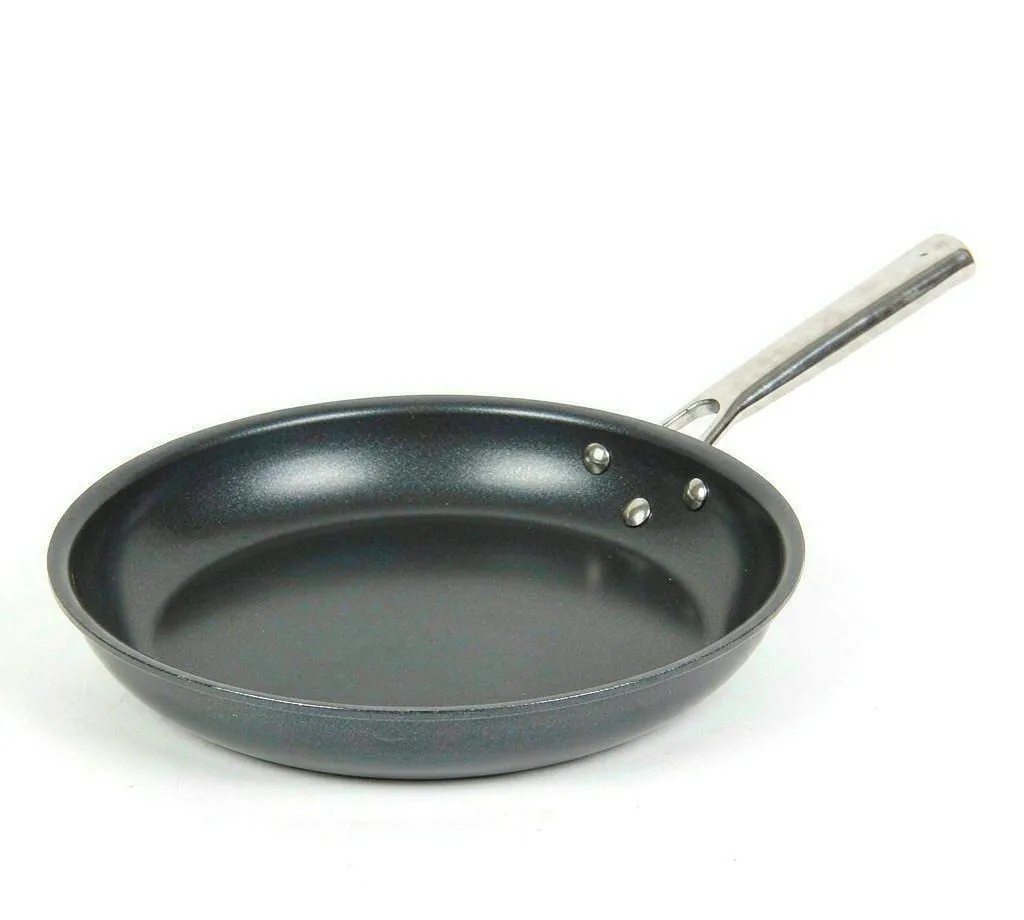 The photograph shows a representative pan from the category. Diameter, coating system and base build follow the order sheet, and the image is illustrative rather than a picture of your goods.
We have sourced frying pans out of Yongkang and Guangdong for five years. The same three failures come back. A coating sold as a multi-layer system arrives as a single thin spray, which lasts a season of home cooking. A base sold as induction-compatible warps on the hob because the magnetic disc was thinned. And a handle that passed on the sample loosens in bulk because the rivet count was reduced.
This page covers what the coating and base words mean, what belongs on the order sheet, and the checks that catch a weak lot. The cluster map is in our wholesale kitchenware overview.
Coating systems and what they cost
The classic non-stick system is PTFE-based, applied in layers: a primer that keys to the metal, mid-coats that carry the thickness, and a topcoat that carries the release. A pan with real layering survives metal utensils longer and releases better in year two. A single-spray pan performs identically on day one and fails by month six, which is why the layer count and the total coating thickness belong on the order sheet as numbers.
Ceramic sol-gel coatings are the alternative family. They arrive slicker, tolerate higher heat and appeal to buyers marketing against PTFE, and they typically lose release faster than a good PTFE system. Neither is wrong. What is wrong is not knowing which one is in the pan, because the two fail differently and the customer’s expectation has to match.
The claims worth pinning are the regulated ones. Food-contact compliance for the coating system, and the absence claim for legacy processing aids, are both paperwork the factory should hold for the exact system being shipped. A report for one coating does not cover a substituted one, and substitution is precisely what happens when a schedule tightens.
Specifications and minimum order
Our minimum order is 1 piece, so you can start with a single unit and scale up once the sample is approved. Every line below changes what the factory builds. We do not print prices or schedules here, because aluminium and coating inputs move; send us the diameter, the base build and the quantity, and we come back with a live quotation and a firm production slot.
| Specification | What to confirm before you order |
|---|---|
| Coating system | PTFE or ceramic, named, with the number of layers and total thickness |
| Compliance | the food-contact report reference for the exact coating system shipped |
| Body | cast, spun or stamped aluminium, with the wall thickness stated |
| Base build | induction disc or plain, with the disc thickness named |
| Handle | rivet count and handle material, since handles are the first mechanical failure |
| Diameters | the sizes in the programme, each as its own tooling line |
| Pedido mínimo | stated per diameter and base build, since each is its own press run |
Minimums in this category track press and coating line setups, and one diameter in one base build is the most consistent way to start. Our sourcing service covers the factory screening, the sample round and the inspections below.
What the base and handle words mean
An induction base is a magnetic disc bonded under the aluminium. Its thickness decides whether the pan couples efficiently with the hob and stays flat under heat, and a thinned disc is invisible until the pan is cooked on. The flatness check catches the cheap build: a base that rocks on a flat surface will never sit evenly on an induction hob.
Handles are the mechanical story of the category. A handle riveted through the pan wall with a full rivet count carries years of lifting; one rivet removed per handle saves the factory seconds and costs the buyer a warranty line. The lift test with a filled pan, on pieces from the bulk lot, is the honest check and it takes seconds.
Two practical points finish the set. Coated pans are packed nested, and unprotected rims scratch the coating of the pan below them, so a rim protector or a bag per pan is a packing decision worth specifying. And the coating edge matters: a coating that stops short of the rim leaves a bare ring that corrodes first, which is a build detail worth checking at inspection.
What belongs in the purchase order
One page attached to the PO is what protects the reorder. Cover these points:
- Coating system, layer count and total thickness, with the report reference
- Body build and wall thickness, and the base disc thickness for induction builds
- Handle rivet count and material
- Diameters and packing method, including rim protection between nested pans
- Care instructions artwork, since coating life depends on how the customer uses it
- A penalty clause if the bulk pan differs from the approved sample
Inspection points that catch a weak lot
These checks find what a product photograph cannot:
- Measure the coating. Check thickness on bulk pans against the specification. A single-spray build is measurably thinner.
- Rocker test the base. Press the rim on a flat surface. A rocking base fails on the hob it was sold for.
- Lift by the handle. Fill a bulk pan and lift it. Movement at the rivets is the warranty failure.
- Cook once. Fry an egg on a bulk pan with no oil. Release and clean-up tell you more than any certificate.
- Check the coating edge. Look at the rim for a bare ring where the coating stopped short.
An independent inspection before loading catches all five at the cheapest point, and the coating thickness check is the one that protects the programme’s reviews. Factory inspection covers this category, and the supply towns behind it are mapped in our kitchenware hotspots guide.
Preguntas frecuentes
PTFE or ceramic coating for a retail range?
PTFE multi-layer for release and durability, ceramic for a heat-tolerant, marketing-friendly build. Both are honest choices; the failure is not knowing which one you bought. Name the system, the layer count and the thickness, and the reorder inherits the decision.
Why do cheap non-stick pans fail so fast?
Because the coating is the cost lever, and a thin single-spray build performs identically until it does not. Thickness is measurable at inspection, which is why it belongs on the order sheet as a number rather than as the word non-stick.
Can one pan serve gas and induction markets?
Yes, with the induction disc build, which works on every hob. The disc adds cost, so some buyers split the programme: plain builds for gas markets and disc builds for induction markets. The decision belongs at order time because the base is bonded before the coating.
Request a quotation
Send the diameter, the coating system, the base build and the quantity you need, plus the market you sell into. We come back with factory options and current bands within two business days.