Made-to-Measure Bridal Gowns from China
Made-to-measure is the bridal trade’s precision end: one gown, one set of measurements, one customer who will notice everything. The workshop work is pattern-making and fitting rather than volume cutting, and the failures are not fabric substitutions but communication ones, because every number that travels between buyer and factory is a chance to be wrong by an inch.
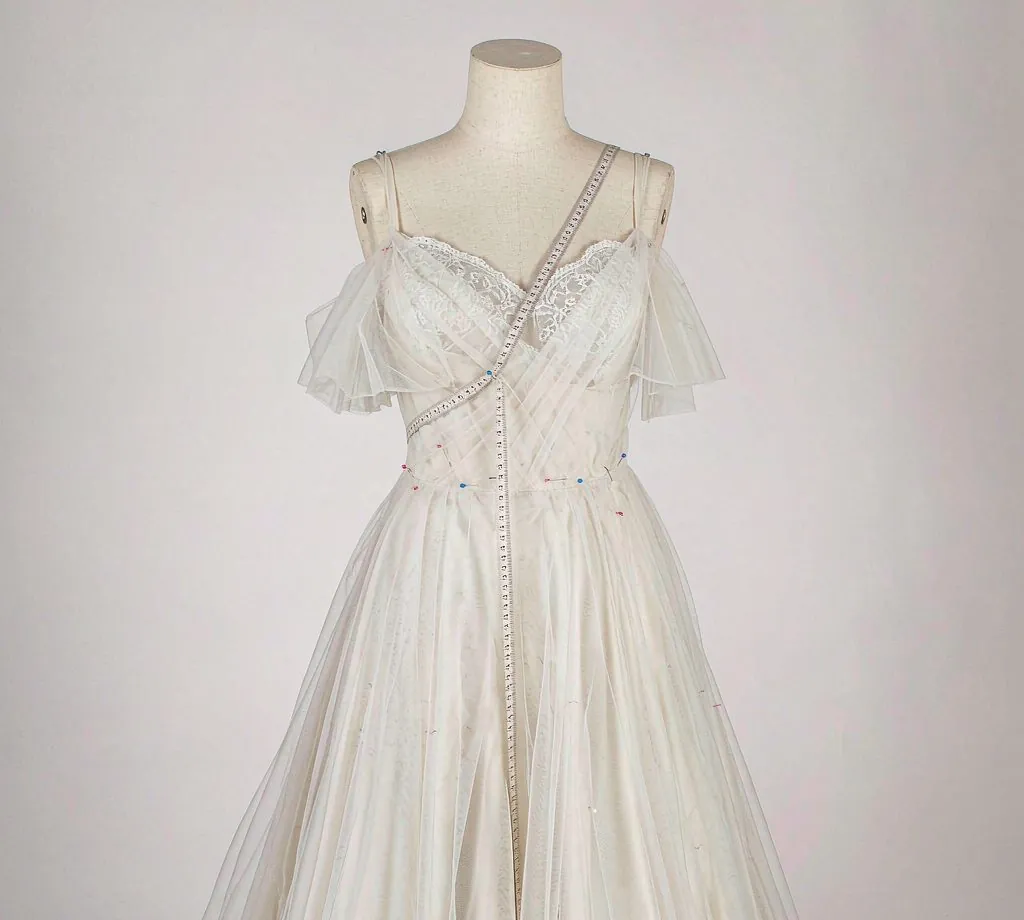 The photograph shows a representative gown in fitting. Every measurement follows the customer’s sheet, and the image is illustrative rather than a picture of the finished goods.
We have managed made-to-measure programmes out of Suzhou and Guangzhou for five years. The same three failures come back. A measurement sheet that mixed centimetres and inches, discovered only on the finished gown. A fitting photo approved too quickly, so a correction that was obvious at the half-made stage reached the finished gown. And ease left undefined, so a gown cut exactly to the body measurements arrived unwearable.
This page covers how a measurement programme should run, what belongs on the order sheet, and the checks that catch an error before the gown ships. The factory towns behind the category are in our wholesale wedding dresses overview.
Measurements, ease and the fitting process
The measurement sheet is the contract. It should list every dimension the pattern needs, in centimetres, marked as body measurements rather than garment measurements. The two are not the same: a gown cut exactly to body measurements has no ease and cannot be worn. The ease, the extra room built into the pattern for movement and underlayers, belongs on the sheet as an explicit decision per area, because it is a design choice rather than a factory choice.
The fitting process is where the money is saved. A half-made gown photographed on a form, reviewed with the factory over a video call, catches a wrong shoulder slope or a misplaced waist seam while it still costs minutes to fix. The discipline is to require photographs at agreed stages, to review them against the sheet rather than against hope, and to write corrections as numbered replies so nothing is absorbed into a general approval.
One gown per order changes the economics. There is no grading, no size set and no bulk run to absorb a mistake, which is why the sheet and the stages matter more here than anywhere else in the trade. A programme that runs on a clear sheet and two photo checkpoints ships gowns that fit; a programme that runs on email threads ships alterations.
Specifications and terms to confirm
Our minimum order is 1 piece, so you can start with a single unit and scale up once the sample is approved. Every line below belongs in the made-to-measure agreement. We do not print prices or schedules here, because they move with the design and the workshop’s calendar; send us the design, the measurement sheet and the quantity, and we come back with a live quotation and a firm programme.
| Item | What to confirm before you commit |
|---|---|
| Measurement sheet | every dimension in centimetres, marked as body or garment measurement |
| Ease | the extra room per area, agreed as a design decision rather than left to the factory |
| Units | centimetres only, stated once, so nothing converts silently |
| Photo checkpoints | the stages at which the workshop photographs the build, and who reviews |
| Corrections | how changes are numbered and confirmed, so no edit is lost in a thread |
| Fabric and lace | named with swatches, since one gown cannot be re-cut cheaply |
| Pedido mínimo | one piece per design by definition, with the per-gown price structure agreed |
A made-to-measure programme carries more communication than any volume order, and it rewards a written process. Our sourcing service covers the workshop selection, the programme management and the final verification below.
What the fitting words mean in practice
A half-made fitting is the checkpoint that pays for the programme. At that stage the shell exists, the seams are open, and a shoulder or waist correction costs minutes. The same correction on a finished gown costs a rebuild. The buyer who reviews the half-made photos against the sheet, and replies in numbered corrections, is the buyer whose finished gowns fit.
Height is the measurement most often forgotten. A gown cut for a customer’s height needs that height stated with the shoe height she will wear, because the hem and the train both depend on it. It is a one-line addition to the sheet that prevents the most common made-to-measure alteration request.
Two practical points complete the programme. Photos should be taken straight-on and in daylight, because angled and warm photos hide a slope and a shade. And the final verification is a measurement exercise: the finished gown measured against its own sheet, item by item, before it is packed. That single step is what a pre-shipment inspection adds.
What belongs in the order
One page attached to the order is what protects the customer relationship. Cover these points:
- Measurement sheet in centimetres, marked as body measurements, with shoe height
- Ease agreed per area as a design decision
- Photo checkpoints at named build stages, with a named reviewer
- Correction process: numbered, written, confirmed by both sides
- Fabric and lace named with retained swatches, plus the lining
- Final verification: the gown measured against its own sheet before packing
Verification points before the gown ships
These checks find what a fitting-room photograph cannot:
- Measure against the sheet. Check every dimension of the finished gown against its own measurement sheet, item by item.
- Check the ease. Confirm the agreed ease is present, since a gown cut to body measurements without it cannot be worn.
- Compare with the corrections. Read the numbered correction list and confirm each edit appears on the gown.
- Inspect the interior. Check the boning, the waist stay and the lining, which are the parts that make one gown wear well.
- Check the hem with the shoe height. Verify the hem and train against the height and shoe allowance on the sheet.
An independent verification before packing is the step that turns a made-to-measure programme from a gamble into a process. Factory inspection covers final checks of this kind, and the factory towns behind the category are mapped in our bridal factory guide.
Preguntas frecuentes
How many photo checkpoints does a gown need?
Two carry most of the value: one at the half-made shell stage and one at the nearly finished stage. The first catches pattern and proportion errors while they are cheap; the second catches finishing details. More checkpoints suit flagship gowns and first-time programmes.
What is the most common measurement mistake?
Unit mixing, followed by missing ease. A sheet that mixes centimetres and inches fails silently, and a gown cut exactly to body measurements fails loudly in the fitting room. Both are prevented by one line of discipline: centimetres only, body measurements marked, ease agreed.
Can made-to-measure work with lace and beading?
Yes, and it is common, but each decorative layer adds fitting variables. Beadwork placed across a seam that moves will need rework, so the design should settle before the bead layout is programmed. That is a sequencing point rather than a limit.
Request a quotation
Send the design, the measurement sheet and the market you sell into. We come back with workshop options, a programme outline and current bands within two business days.