
Wholesale Battery-Operated and RC Toys from China
A battery-operated toy is the same plastic shell with a motor, a radio and a power source inside it, and those three additions are where the money, the paperwork and the returns live. The category sits across two very different supply bases: the Chenghai plastic cluster builds the shells, and the Dongguan electronics belt builds the boards, motors and handsets that go into them.
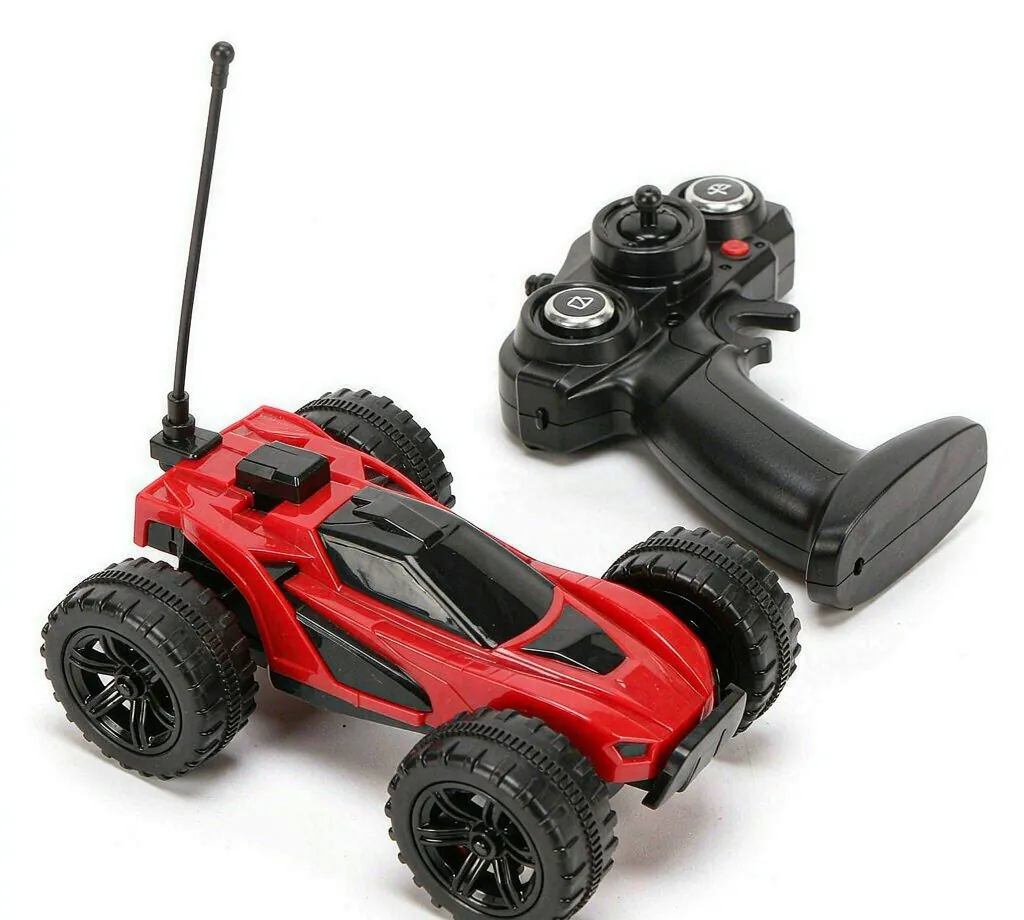 The photograph shows a representative unit of the category. Frequency band, battery configuration and packaging follow the order sheet, and the image is illustrative rather than a picture of your goods.
We have sourced electronic toys out of both clusters for five years. The same three failures come back. A handset is sold as 2.4GHz and arrives on a legacy band that interferes with everything else in a home. A battery is rated at a capacity the cell inside cannot hold. And a battery bay that needs a screwdriver on the sample arrives with a snap-on cover in bulk, which fails the child-safety rule on both sides of the Atlantic.
This page covers what the radio and battery words mean in practice, what belongs on the order sheet, and the checks that catch a weak lot. The cluster structure behind it is mapped in our wholesale toys overview.
Radio, motor and power: the three engineering choices
Radio is the first choice, and it decides which markets the toy can enter. The 2.4GHz band is the default for anything sold today: it pairs without a crystal swap, it does not fight with older handsets nearby, and it is what the current radio approvals on both sides of the Atlantic assume. Legacy bands still exist for cost reasons and still work, but they carry their own approval route and a shorter shelf life in retail. Ask which band the board is built on, in writing.
Motor and gearbox decide how the toy feels. A brushed motor with a plastic gearset is the volume build; it is fine for a toy that runs on a floor and is not fine for one that climbs. Metal gears, ball bearings and a heat sink are what separate a hobby-grade unit from a supermarket one, and each step is visible on the invoice if the factory is asked to name it.
Power is the third choice and the one with the most regulation attached. Cell packs, lithium packs and USB-rechargeable builds each carry a different transport rule, a different charger approval and a different failure mode. Most returns in this category are not motor failures. They are charging failures.
Specifications and minimum order
Our minimum order is 1 piece, so you can start with a single unit and scale up once the sample is approved. Every line below changes what the factory builds or what paperwork travels with the goods. We do not print prices or schedules here, because cell prices and factory calendars both move; send us the platform, the frequency and the quantity, and we come back with a live quotation and a firm slot.
| Specification | What to confirm before you order |
|---|---|
| Radio band | 2.4GHz or a legacy band, named, with the pairing behaviour described |
| Battery chemistry | lithium pack, single cells or USB-rechargeable, since each has a different transport rule |
| Battery bay | screwed or tool-operated for cell products, and the screw size stated on the artwork |
| Charger | the approval the adapter carries, plus the plug types in the box for each market |
| Motor and gearset | brushed or brushless, plastic or metal gears, stated rather than implied |
| Run time | the figure quoted, the load it was measured under, and the cell capacity it assumes |
| Pedido mínimo | stated per frequency version, because each radio version is its own build |
Minimums here sit above plain plastic toys because every electronic build carries a test round and an approval route of its own. Splitting a launch across several frequency versions multiplies the setup work. Our sourcing service covers the factory screening, the sample round and the checks set out below.
How battery and radio rules shape the order
Cell-powered toys in the United States must meet the child-safety rule on battery compartments, which in practice means a bay a child cannot open without a tool. That requirement travels with the product, not with the market, so a build designed for Europe and shipped to America unchanged is a compliance failure waiting for an audit.
Lithium packs add a transport layer. A pack needs a test summary for transport, a safety datasheet, and packaging that meets the air-freight instruction for the watt-hour rating involved. This is paperwork the factory should already hold for its standard pack, and asking for it early is what keeps a shipment from sitting at an airport.
Radio equipment adds a third layer. Buyers selling into the United States need the radio approval for the module used, and buyers selling into Europe need the radio equipment directive approval with the correct band and power limits. Both approvals are held against the exact board revision in the product, which is why a board swap late in a project is never a small change.
What belongs in the purchase order
One page attached to the PO is what protects the reorder. Cover these points:
- Platform name and board revision, with the radio band stated explicitly
- Battery chemistry, cell capacity and the transport paperwork that ships with it
- Charger approval, plug types per market, and the cable length and connector type
- Battery bay construction, including the tool required to open it
- Age grading matched to the test report, and the warning text approved on the artwork
- A penalty clause if the bulk build differs from the approved sample
Inspection points that catch a weak lot
These checks find what a product photograph cannot show:
- Charging cycle. Charge and discharge units drawn from the bulk. Most failures in this category appear here, not on the motor bench.
- Battery bay. Try to open the bay by hand, then with the tool named on the artwork. A bay that opens without the tool is a compliance failure.
- Radio pairing and range. Pair every unit in the sample and walk the stated range in an area with other radios running.
- Switch and button life. Cycle the power switch and the main buttons repeatedly on one unit. Cheap switches fail long before the motor does.
- Drop the packed unit. Drop it from the height its age grade implies and check that the shell, the battery contacts and the antenna survived.
An independent inspection before loading is what keeps an electronic toy from being discovered in the customer’s hands, and the pre-shipment stage is where the cost of a defect is still small. Factory inspection covers this category, and the same sample-versus-bulk discipline is set out in our pre-shipment inspection guide.
Preguntas frecuentes
Do batteries ship installed in the toy?
Usually not for lithium, because installed packs change the transport classification and the paperwork with it. Cell-powered toys often ship with cells loose in the box or excluded entirely, depending on the market and the retailer’s own rules. Decide this before the packaging artwork is printed, since a box that promises batteries in the box cannot be changed afterwards.
Can one build serve several markets?
One hardware build can usually serve several markets if the radio module and the charger are chosen with that in mind, but the approvals differ and the packaging plug set differs as well. The efficient approach is one build with market-specific charger sets and artwork, rather than separate boards for each market.
How do I check a claimed run time?
Ask the factory what load the figure was measured under and what cell capacity it assumes, then verify the capacity of a sample cell yourself. A run time quoted without those two facts is a marketing number, and the load figure is the one that matters in real play.
Request a quotation
Send the platform, the radio band, the battery configuration and the quantity you need, plus the market you sell into. We come back with factory options and current bands within two business days.
