
Wholesale Automatic Pet Feeders from China
An automatic pet feeder is a promise the customer makes to an animal: food will arrive on time. The product keeps that promise with a hopper, an auger and a schedule, and it breaks the promise in three specific ways, which are a jam the customer cannot fix, a portion that drifts from the setting, and a firmware build nobody can update.
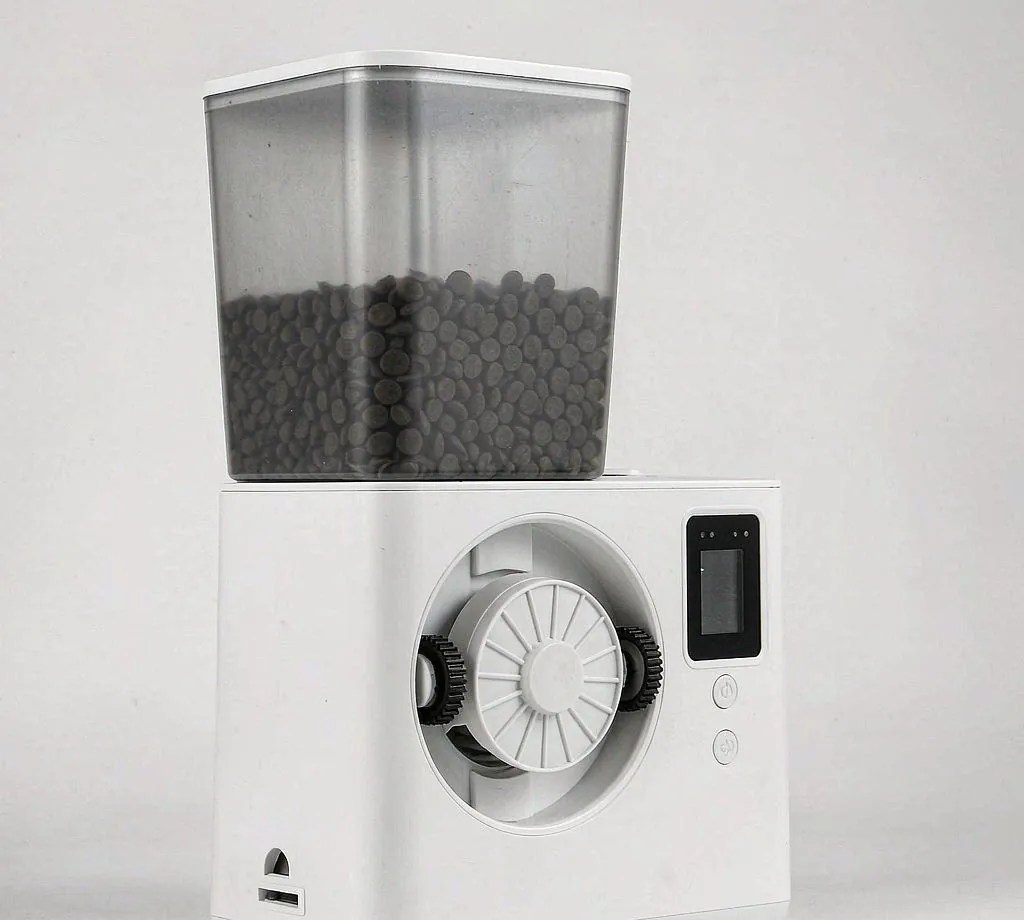 The photograph shows a representative feeder from the category. Capacity, portion settings and app features follow the order sheet, and the image is illustrative rather than a picture of your goods.
We have sourced feeders from the Shenzhen and Dongguan electronics belt for five years. The same three failures come back. A feeder that portions perfectly on the sample jams on the kibble size the customer actually uses. A battery-backed schedule forgets itself after a power cut. And an app pairing that worked at the factory fails in a house with ordinary wifi, which generates the review that no feeder survives.
This page covers what the portion and schedule words mean, what belongs on the order sheet, and the checks that catch a weak lot. The wider category is in our wholesale pet supplies overview.
Hopper, auger and schedule
The hopper and auger decide the jam behaviour. Kibble varies in size and shape more than buyers expect, and an auger tuned to one pellet size jams on another. The honest specification names the kibble range the feeder handles, and the test is physical: run the feeder through a bag of the largest kibble the packaging claims, from the bulk lot, before the cartons are packed.
Portion accuracy is the second specification. A feeder that dispenses a consistent portion builds trust; one that drifts between settings generates the reviews that say the dog gained weight or went hungry. Portion accuracy is measurable: run each setting a dozen times on bulk units and weigh the output. The tolerance belongs on the order sheet as a number.
The schedule is the promise itself. A feeder needs to keep its schedule through a power cut, on batteries, and after the customer’s router reboots. Each of those is a design decision, and each is testable. Feeders that fail the recovery test fail in the first month of ownership, which is precisely when reviews are written.
Specifications and minimum order
Our minimum order is 1 piece, so you can start with a single unit and scale up once the sample is approved. Every line below changes what the factory builds. We do not print prices or schedules here, because electronics inputs move; send us the capacity, the connectivity and the quantity, and we come back with a live quotation and a firm production slot.
| Specification | What to confirm before you order |
|---|---|
| Hopper capacity | stated in litres, with the kibble size range it handles |
| Portion accuracy | the tolerance agreed, verified by weighing repeated dispenses |
| Jam behaviour | what the feeder does when it jams, and whether the customer can clear it |
| Schedule memory | behaviour after a power cut, on battery backup, stated as a test |
| Connectivity | app pairing requirements and the wifi bands supported |
| Approvals | the electrical approval per market, naming the exact build |
| Minimum order | stated per connectivity version, since each is its own board and build |
Minimums in this category track electronics builds and certification runs, and one connectivity version is the most consistent way to start. Our sourcing service covers the factory screening, the sample round and the verification tests below.
What the firmware and approval words mean
Firmware is part of the product. A build that cannot be updated turns every discovery into a returned unit; a build with a clear update path turns the same discovery into a patch. The update mechanism, the language set and the behaviour on failure belong in the specification, because they are decisions the buyer lives with after the sale.
Electrical approvals are build-specific, exactly as they are for any appliance. A certificate names the board and the power circuit it was issued for, and a component substitution invalidates it. The honest check reads the certificate at the factory and matches it to the units on the line, which is part of any pre-shipment inspection for electronics.
Two practical points complete the set. Sealed hoppers keep kibble fresh and keep humidity out, and the seal quality matters more in humid destinations than any feature list suggests. And the tray is the part that gets washed, so its material and its removal mechanism decide whether the product survives daily life.
What belongs in the purchase order
One page attached to the PO is what protects the reorder. Cover these points:
- Hopper capacity and the kibble size range the feeder handles
- Portion accuracy tolerance, verified by repeated weighed dispenses
- Jam behaviour and the customer-side clearing path
- Schedule memory through a power cut, on battery, as a test
- Firmware update path and the app pairing requirements
- A penalty clause if the bulk build differs from the approved sample
Inspection points that catch a weak lot
These checks find what a product photograph cannot:
- Run the portions. Dispense each setting a dozen times on bulk units and weigh the output against the tolerance.
- Jam it on purpose. Run the largest kibble the packaging claims through bulk units. A jam the customer cannot clear is a return.
- Cut the power. Pull the mains and confirm the schedule survives on the battery.
- Pair the app. Pair bulk units in a real wifi environment, not the factory’s own network.
- Match the certificate. Read the electrical approval and match it to the boards on the line.
An independent inspection before loading catches all five at the cheapest point, and the jam test is the one that predicts the reviews. Factory inspection covers this category, and the same pre-shipment discipline is set out in our inspection guide.
Frequently asked questions
What kibble size should the feeder be specified for?
The range the packaging claims, tested on the bulk lot with the largest kibble in that range. Jams happen at the top of the range, and a feeder that handles the claim is the one that earns the reviews. The claim and the build have to match, in writing.
Does battery backup matter?
Yes, because a power cut that erases the schedule breaks the promise the product was bought for. The recovery test, mains off and schedule intact, is quick and it is the difference between a feeder and a toy.
Can one build serve several markets?
The hopper and the mechanics can, but the plug, the radio and the approval cannot all be shared. The efficient structure is one mechanical build with market-specific power and connectivity, agreed before production, because the board is the build.
Request a quotation
Send the capacity, the connectivity, the portion settings and the quantity you need, plus the market you sell into. We come back with factory options and current bands within two business days.
