
Wholesale Cat Trees from China
The cat tree is flat-pack furniture for cats, and it inherits every failure mode that flat-pack furniture has, plus one the cat adds: a wobble at the base becomes a toy, and a toy becomes a dismantled tower. The category is built in the Shandong and Hebei belt out of board, sisal and plush, and its quality lives in three invisible places: the board thickness, the post cores and the hardware kit.
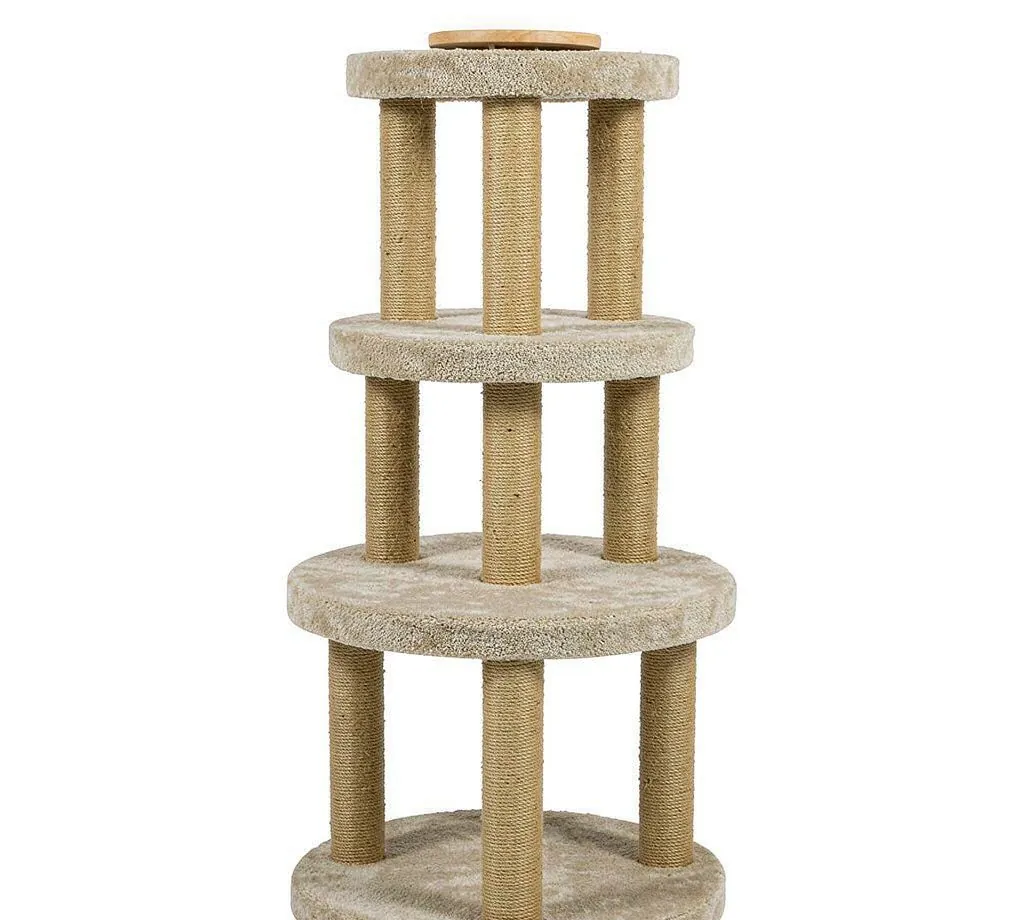 The photograph shows a representative cat tree from the category. Height, platform layout and carpet colour follow the order sheet, and the image is illustrative rather than a picture of your goods.
We have sourced cat furniture from that belt for five years. The same three failures come back. A board sold at one thickness arrives a few millimetres lighter, which shows up as lean rather than as a measurement. A sisal post wound loosely unravels in the first month. And a hardware kit missing one bolt is a customer assembling a tower with a hole in it, at home, on a Sunday.
This page covers what the board and post words mean, what belongs on the order sheet, and the checks that catch a weak lot. The cluster picture is in our wholesale pet supplies overview.
Board, posts and the base
The board is the skeleton. Thickness decides both the load the tower carries and the stability the cat experiences, and it is the specification most often thinned because a few millimetres across hundreds of panels is real money. The thickness belongs on the order sheet as a number, and the caliper check at inspection is how it is verified.
The scratching post is a sisal rope wound around a core. The core can be cardboard tube, board or solid post, and each behaves differently when a cat leans on it. The winding matters as much: a tight, glued wrap with butt-joined rows lasts a year; a loose wrap unwinds from the top. Both are visible on the bulk lot if someone actually winds a hand around the post.
The base is the physics. A tall tower with a light base tips when the cat jumps off the top platform, and the wobble becomes entertainment. Base dimensions and board thickness together decide stability, and the honest test is a lateral push on the assembled unit, which is exactly what a pre-shipment inspection does on a sample assembly.
Specifications and minimum order
Our minimum order is 1 piece, so you can start with a single unit and scale up once the sample is approved. Every line below changes what the factory builds. We do not print prices or schedules here, because board and plush inputs move; send us the height, the layout and the quantity, and we come back with a live quotation and a firm production slot.
| Specification | What to confirm before you order |
|---|---|
| Board thickness | the figure in millimetres for panels and base, verifiable by caliper |
| Post cores | the core material named, since it decides how the tower leans |
| Sisal winding | the wrap tightness and glue requirement, stated in writing |
| Plush | fabric weight and pile, referenced to a swatch |
| Hardware kit | the complete bolt list with spares, counted per carton |
| Assembly | the tool required and the instruction sheet language set |
| Minimum order | stated per layout and colour, since each is its own cutting run |
Minimums in this category track cutting and wrapping setups, and one layout in one colour is the most consistent way to start. Our sourcing service covers the factory screening, the sample round and the inspections below.
What the plush and hardware words mean
Plush is the surface the customer photographs and the cat claws. Fabric weight and pile decide whether the tower looks new after a season or threadbare in a month. A swatch retained by both sides fixes the reference, because a lighter plush on the bulk run photographs identically and wears entirely differently.
The hardware kit is the most common assembly complaint in the category, and it is purely a counting problem. A kit missing one bolt, or supplied with the wrong length, stops the customer mid-assembly and generates the review that no tower survives. The kit belongs on the order sheet as an itemised list, with spares, and the carton check at inspection counts it.
Two practical points complete the set. Cat trees ship flat and heavy, and corner damage to the plush in transit is the arrival claim, which is packing. And the instruction sheet is part of the product: a diagram that does not match the hardware kit generates the same complaint as the missing bolt.
What belongs in the purchase order
One page attached to the PO is what protects the reorder. Cover these points:
- Board thickness for panels and base, stated in millimetres
- Post core material and the sisal winding standard
- Plush weight and colour, referenced to a retained swatch
- Hardware kit itemised, with spares, and the instruction sheet
- Packing that protects plush corners in a sea container
- A penalty clause if the bulk lot differs from the approved sample
Inspection points that catch a weak lot
These checks find what a product photograph cannot:
- Caliper the board. Measure panel thickness on bulk pieces. A few millimetres thinned is a lean the customer will feel.
- Assemble one. Build a unit from the bulk lot and push it sideways. Wobble at the base is the return the reviews mention.
- Wind the post. Run a hand around the sisal on bulk posts. A loose wrap lifts and unravels.
- Count the hardware. Open cartons and count the kits against the itemised list, including spares.
- Check the plush. Compare weight and pile against the swatch, and look for transit damage on packed units.
An independent inspection before loading catches all five at the cheapest point, and the assembled-unit stability test is the one that predicts the reviews. Factory inspection covers this category, and the same verification method is set out in our pre-shipment guide.
Frequently asked questions
How thick should the board be?
Thick enough that the assembled tower does not lean, which for taller layouts usually means the heavier end of the common panel range. The number belongs on the order sheet in millimetres, and the caliper check at inspection is what makes the number real.
Cardboard or solid post cores?
Cardboard tube cores are the volume build and are fine for lighter cats and shorter towers. Solid or board cores suit tall layouts and strong cats, because the lean starts in the core. The core is invisible once wrapped, which is why it is named on the invoice.
Why do hardware kit complaints dominate reviews?
Because a missing bolt stops the assembly and the customer has no spare, and the review writes itself. The fix is an itemised kit with spares and a carton count at inspection, which costs minutes and protects every unit in the shipment.
Request a quotation
Send the height, the layout, the plush colour and the quantity you need, plus the market you sell into. We come back with factory options and current bands within two business days.
