
Wholesale Lace Wedding Gowns from China
A lace gown is where bridal manufacturing shows its real skill level. The lace has to be cut so the pattern keeps running, placed so motifs meet at the seams, and appliqued by hand where the design calls for it. Every one of those steps is labour, and every one of them is where a factory under pressure cuts corners in ways a photograph cannot show.
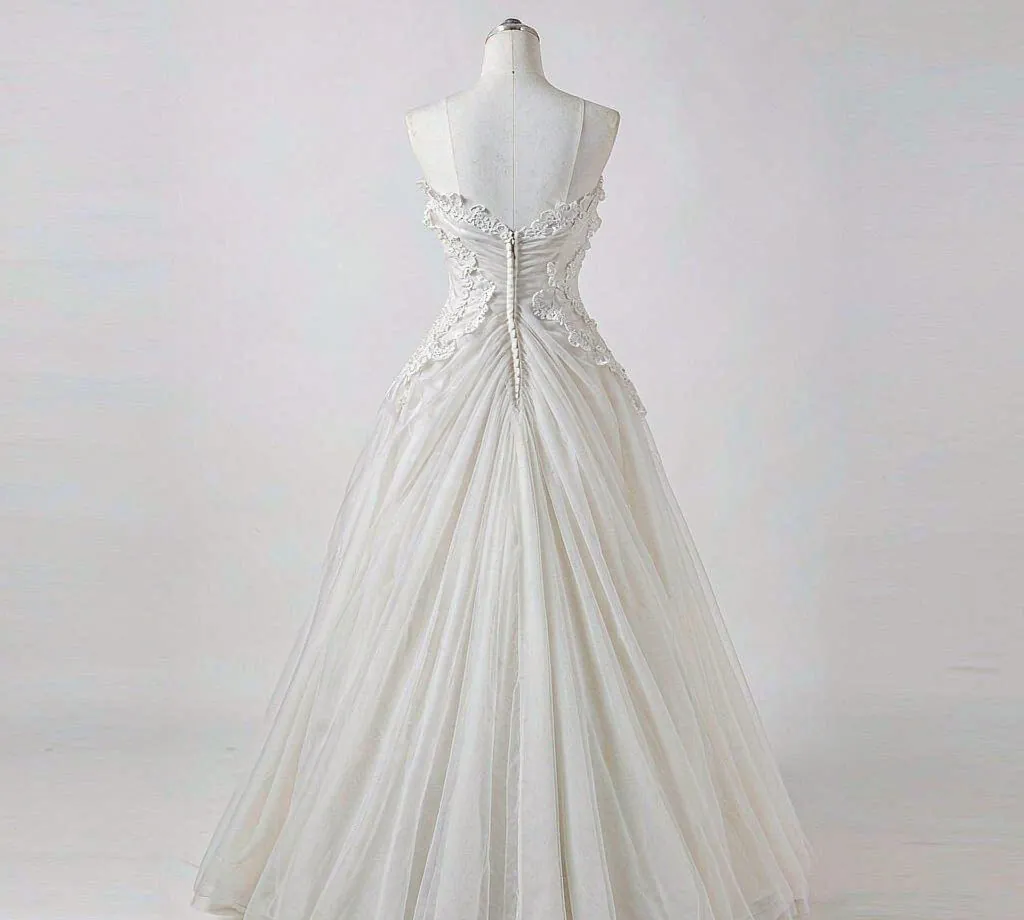 The photograph shows a representative gown from the category. Lace type, bodice design and skirt build follow the order sheet, and the image is illustrative rather than a picture of your goods.
We have sourced lace gowns out of Suzhou and Chaozhou for five years. The same three failures come back. Motifs that met at the waist on the sample collide in bulk, because the cutter stopped matching them. Applique that was hand-stitched on the sample arrives glued. And a lace sold as one grade is a narrower, stiffer version of itself, which reads as costume the moment it moves.
This page covers what the lace words mean, what belongs on the order sheet, and the checks that catch a weak lot. The wider picture is in our wholesale wedding dresses overview.
Lace types and what they cost the factory
Guipure is a connected lace without a net ground: heavy, structured and durable, and the easiest of the laces to apply because the motifs carry themselves. Eyelash lace is a net-based lace with a scalloped edge, and it is the look most bridal customers mean when they say lace. French lace is the premium tier with finer thread and better definition, and honest factories price the difference instead of hiding it.
The cut matters as much as the type. A skilled cutter follows the motif outline so the pattern keeps running across the bodice; an unskilled cut saves minutes and loses the design. That labour is the reason two lace gowns of the same silhouette sit far apart in price, and it is the reason the seam-matching check exists.
Applique is the third tier of labour. Motifs stitched onto the gown by hand can be placed individually, which is how a bodice reads designed rather than assembled. Glued applique looks close on the day it ships and lifts or stiffens after dry cleaning, so the application method belongs on the order sheet in writing.
Specifications and minimum order
Our minimum order is 1 piece, so you can start with a single unit and scale up once the sample is approved. Every line below changes what the factory cuts or applies. We do not print prices or schedules here, because lace prices and workshop calendars both move; send us the lace type, the bodice design and the quantity, and we come back with a live quotation and a firm production slot.
| Specification | What to confirm before you order |
|---|---|
| Lace type | guipure, eyelash or French lace, named, with a swatch as reference |
| Pattern matching | motifs continuing across seams, stated as a requirement with a tolerance |
| Applique method | hand-stitched or glued, named, since glue fails at the dry cleaner |
| Bodice build | boning, cups and lining, itemised rather than implied |
| Skirt | tulle layers and their grammage, since one layer changes the silhouette |
| Size set | the sizes and the measurement chart, per size, in centimetres |
| Minimum order | stated per lace and colour, since each lace is its own cutting run |
Minimums in lace gowns are higher than in plain stock because the cutting and application are hand work. Our sourcing service covers the factory screening, the sample round and the inspections below.
What the semi-custom words mean
Semi-custom usually means a base pattern with agreed changes: a neckline, a train length, a sleeve, a back design. The changes look small on paper and each one touches the pattern, the lace layout or both. The honest way to buy is to list every change on the order sheet and require a photographed sample of the changed design, because a verbal change is a design the factory improvises.
Lace stretch is the hidden variable. Some laces stretch on the bias and some do not, and a bodice cut from a stretching lace fits differently from the same bodice in a rigid one. That is why the swatch matters: it fixes the lace’s behaviour, not just its look, and the reorder inherits the reference instead of a photograph.
Two practical points finish the set. Dyed lace lots drift, so an ivory gown ordered across two production runs needs one dye lot or an explicit tolerance. And beading on lace is a separate line in the specification, because it mixes the two categories’ failure modes and needs its own checks.
What belongs in the purchase order
One page attached to the PO is what protects the reorder. Cover these points:
- Lace type with a retained swatch, and the application method stated
- Pattern-matching requirement at the named seams, with a tolerance
- Applique method, hand-stitched or glued, named in writing
- Bodice construction and skirt layers, itemised
- Size chart in centimetres and the semi-custom changes listed one by one
- A penalty clause if the bulk lot differs from the approved sample
Inspection points that catch a weak lot
These checks find what a product photograph cannot:
- Follow the motifs. Trace the lace pattern across the side seams and the waist. A break in the pattern is the cutting shortcut.
- Test the applique. Lift the edge of an applique gently. Glued pieces lift; stitched pieces stay down.
- Compare the lace. Hold bulk lace against the retained swatch in daylight. A narrower or stiffer lace is a downgrade.
- Count the tulle. Check the skirt layer count against the specification, and hold a layer to the light for sheerness.
- Measure the sizes. Check the extreme sizes of the set against the chart, where grading shortcuts show first.
An independent inspection before loading is where all five are cheap to catch, and in lace gowns the seam-matching check is the one that separates a skilled factory from a cheap one. Factory inspection covers this category, and the evening-wear side of the same cluster is set out in our evening gown guide.
Frequently asked questions
Which lace should a first bridal order use?
Eyelash lace on net is the dependable default: it is the look customers expect, it takes dye consistently, and skilled factories in both clusters cut it well. Guipure suits heavier, structured designs. French lace earns its price on flagship pieces but is not where a first order should learn the category.
Can I mix lace types in one gown?
Yes, and good designs do: a structured guipure bodice with an eyelash skirt is a common combination. Each lace is its own cutting run, so the combination adds setup, but the visual result is the reason semi-custom bridal exists at all.
How do I stop lace arriving crushed?
Specify the packing: individual bags, tissue at the bodice, and a hanger or fold method agreed on the sample. Lace recovers from a soft fold and never fully recovers from a hard one, and the difference is a packing decision made at the factory bench.
Request a quotation
Send the lace type, the bodice design, the size set and the quantity you need, plus the market you sell into. We come back with factory options and current bands within two business days.
