
Wholesale Flat Pack Wardrobes from China
A flat pack wardrobe is a product that a customer assembles alone, in a bedroom, with the manual in front of them. That makes the instructions, the fittings and the panel accuracy part of the quality rather than an accompaniment to it.
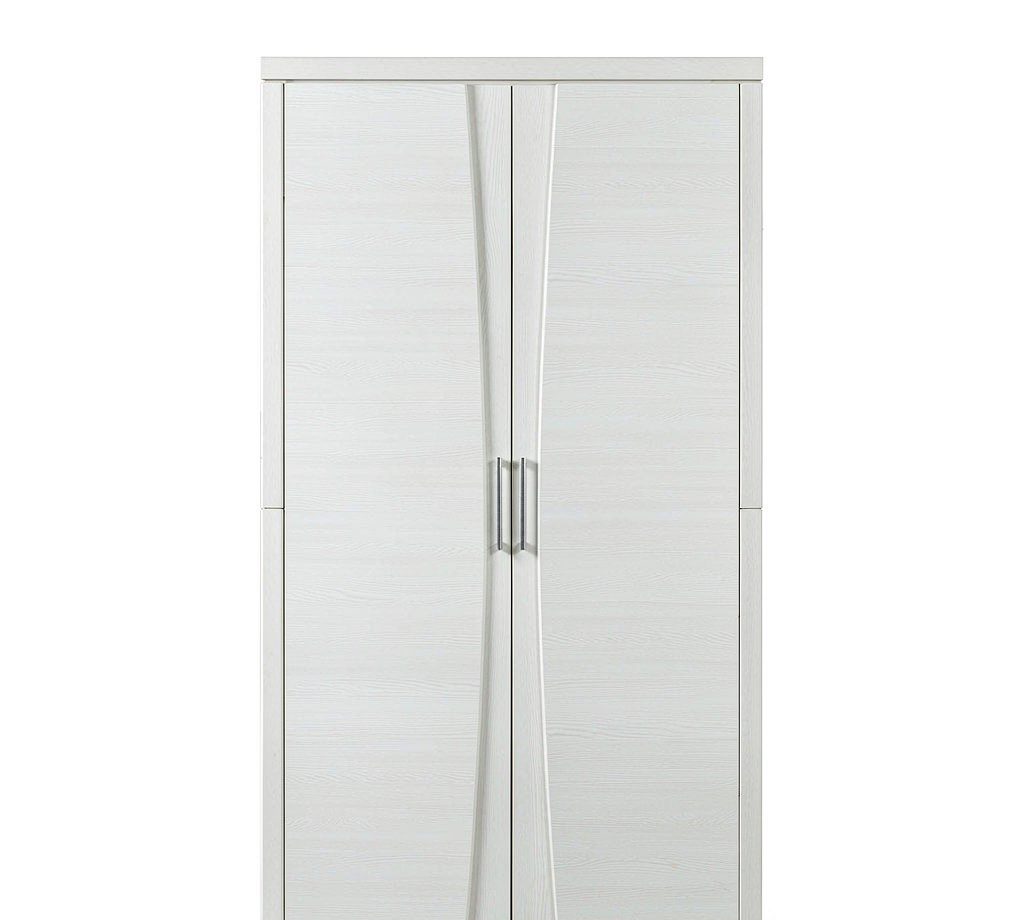 The photograph shows a representative wardrobe from the category. Finish, door style and handle follow the approved sample, and the image is illustrative rather than a picture of your goods.
We have sourced knock down furniture out of the Guangdong and Zhejiang clusters for years. Three failures repeat. A panel board sold at a stated grade arrives thinner or with a lower density core that does not hold a screw. Edge banding that looked seamless on a sample arrives with a visible line that lifts after a season. And a carton whose weight creeps above the stated figure, which turns a freight assumption into a cost.
This page covers what the board and fitting words mean, what belongs on the order sheet, and the checks that catch a weak lot. The supply base behind the category is in our wholesale furniture overview.
Board, edge banding and fittings
The board is the structure and the surface at once. Particle board is the usual choice for knock down furniture, and its grade describes the density of the core and the quality of the surface. Density decides how well a panel holds a screw or a cam fitting, and surface quality decides how a laminate or a veneer behaves over time.
Edge banding is the finished edge of every panel and the detail that most reveals price. The banding thickness, the adhesive and the trimming method decide whether the edge looks seamless and whether it stays on as the panel flexes. A thin band with a poor bond lifts, and a lifted edge is the first thing a customer sees when the wardrobe is assembled.
Fittings are the interface between panels and the customer’s hands. Cam locks, dowels, hinges and handles are all small parts with quality differences, and the assembly experience depends on them more than on the board. A cam that does not tighten squarely makes a panel sit proud and the whole unit look wrong.
Specifications and minimum order
Our minimum order is 1 piece, so you can start with a single unit and scale up once the sample is approved. Every line below changes what the factory cuts and packs. We do not print prices or schedules here, because board and hardware inputs move; send the sizes, the board grade and the quantity, and we come back with a live quotation and a firm production slot.
| Specification | What to confirm before you order |
|---|---|
| Board | thickness, core density and the surface finish |
| Edge banding | thickness, adhesive type and the trimming method |
| Panel accuracy | dimensions and hole positions against the drilling pattern |
| Fittings | cam locks, dowels, hinges and handles, each with a grade |
| Instructions | language set, drawing quality and the parts list accuracy |
| Packing | edge protection, carton weight and how the panels are stacked |
| Minimum order | stated per finish and per size, since board is cut and edged in runs |
Minimums in knock down furniture are driven by the board run and the packaging print, so one finish across a small size range holds cost down. Our sourcing service covers the factory screening, the sample round and the inspections below.
What the board and fitting words mean in practice
Panel accuracy is the whole assembly experience. Every hole in a knock down unit is drilled to a pattern, and a small drift between panels shows as a gap at a joint, a door that does not hang square or a drawer that rubs. Because the error compounds along the unit, the tolerance belongs in the specification rather than in a final inspection.
Instruction quality is a genuine quality feature in this category. A customer assembling alone relies on a drawing, and a drawing that is unclear or a parts list that is wrong generates a support request rather than a sale. The language set and the drawing standard belong in the order, and a trial assembly by someone who did not design the unit is the honest test.
Carton weight is a commercial detail with a quality consequence. Board weight is easy to read from a specification and easy to drift from in production, and a carton that gains weight changes the freight calculation for the whole shipment. Weighing a sealed carton is the check.
What belongs in the purchase order
One page attached to the PO is what protects the reorder. Cover these points:
- Board thickness, core density and surface finish
- Edge banding thickness and adhesive type
- Panel dimensions and hole pattern tolerance
- Fitting grades for hinges, cams, dowels and handles
- Instruction language set and drawing standard
- A penalty clause if the bulk lot differs from the approved sample
Inspection points that catch a weak lot
These checks find what a product photograph cannot:
- Assemble one. Build a bulk unit from a sealed carton using only the supplied instructions. This is the test that finds every other problem.
- Run a finger along the edge. Look for a raised line or a lifted band, which is where a thin banding starts to fail.
- Drive a screw twice. Fix and remove a screw in a bulk panel and check that the hole still holds.
- Weigh a carton. Compare a sealed carton against the stated weight, because board weight drifts quietly in production.
- Check hole alignment. Measure the drilling pattern on two mating panels and check them against the drawing.
An independent inspection before loading catches all five at the cheapest point. Factory inspection covers this category, and the wider system is set out in our guide to the sample versus bulk gap.
Frequently asked questions
What board is used in flat pack furniture?
Particle board is the usual core material, with a laminate or a veneer on the face and edge banding on every cut edge. The grade describes the core density and the surface, and density is what decides how well the panel holds a screw or a cam fitting.
How do I check the instructions before shipping?
Have someone who did not design the unit build one from a sealed carton using only the supplied manual. That single test finds unclear drawings, missing parts and mislabelled fittings, all of which otherwise become customer support requests.
Why does carton weight matter?
Because freight is calculated on weight and volume, and board weight drifts in production without anyone noticing. A carton that gains weight changes the cost of the whole shipment, so weighing a sealed carton is a commercial check as much as a quality one.
Request a quotation
Send the sizes, the board grade, the finish and the quantity you need, plus the market you sell into. We come back with factory options and current bands within two business days.
